ACP Cladding for Commercial Buildings: Why Tamil Nadu’s Commercial Buildings Are Being Redesigned From the Outside In
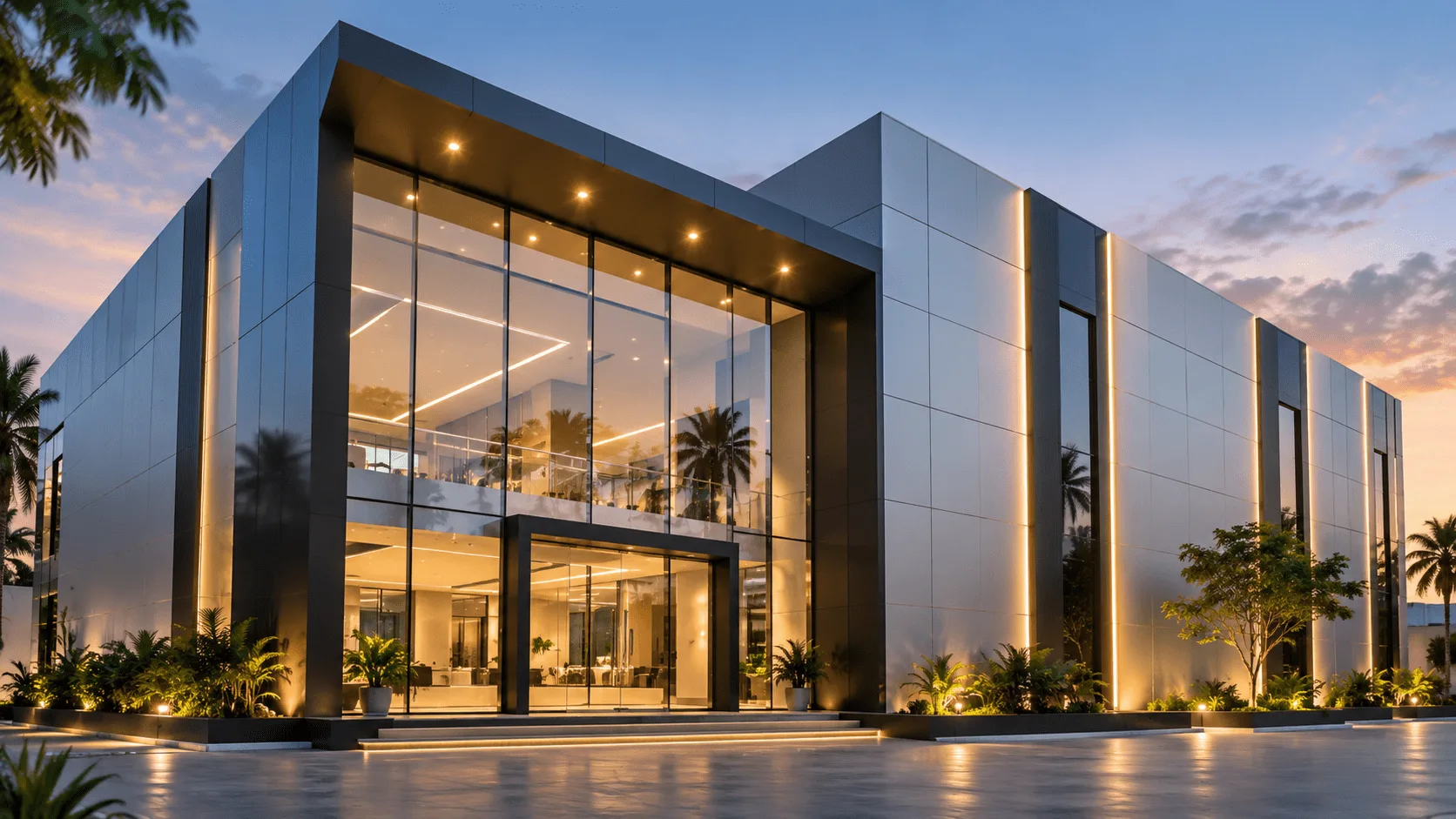
Across Tamil Nadu, commercial façade specialists such as Galaxy Facade are seeing growing demand for integrated exterior solutions that combine ACP cladding, structural glazing, architectural lighting, and premium signage into a unified branding system.
As competition intensifies across retail, healthcare, hospitality and corporate real estate, businesses are treating the building exterior as a strategic asset rather than a construction afterthought — and Aluminium Composite Panel cladding has emerged as the material around which this shift is being built.
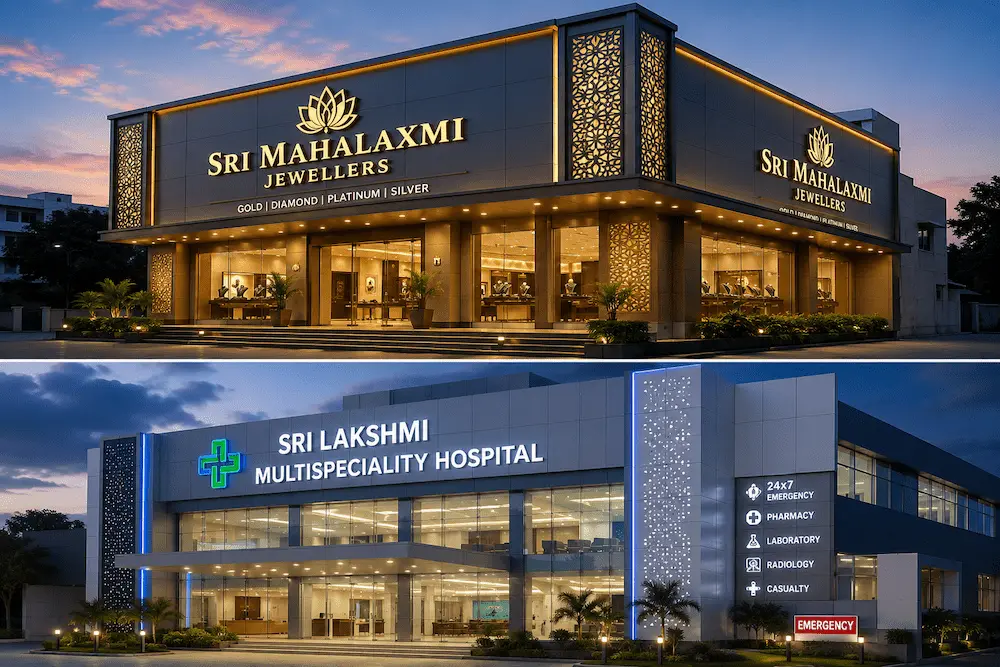
Commercial ACP Cladding has become one of the most influential developments in modern commercial architecture across Tamil Nadu. From jewellery showrooms and hospitals to retail stores and corporate offices, businesses are increasingly investing in integrated façade systems to improve branding, visibility, and long-term value.
This is not simply a matter of aesthetics catching up with ambition. It reflects a more fundamental change in how business owners think about the building itself — not as overhead, but as the first and most persistent point of contact a brand has with its customer.
Why Commercial ACP Cladding Has Become a Business Investment
Retail psychology has established, over decades of study, that customers form judgments about a business well before they interact with a single product or staff member. That principle has always been true; what has changed is the extent to which businesses in competitive, trust-sensitive categories — jewellery, healthcare, textiles, premium hospitality — are willing to act on it.
Consider the logic from a business owner’s point of view. A gold jewellery showroom is, at its core, selling confidence as much as carats. A private hospital is selling reassurance before it delivers treatment. A restaurant is selling an experience before the first plate ever reaches the table. In each of these cases, an exterior that looks dated, faded or improvised undercuts the very impression the business is trying to create — irrespective of the quality of what lies inside.
There is also a simpler, more measurable driver: visibility. On commercial roads crowded with competing establishments, a distinctive, well-lit façade can be the difference between a passing customer noticing a business and driving past it. In a market where walk-in footfall still accounts for a meaningful share of retail sales even as e-commerce grows, that visibility has a direct, if difficult to isolate, effect on revenue.
Taken together, these pressures explain why the commercial façade has moved from being a line item under “maintenance” to a line item under “brand investment” in the way many businesses now plan their budgets.
The material behind the shift: what ACP cladding actually is, and why it matters
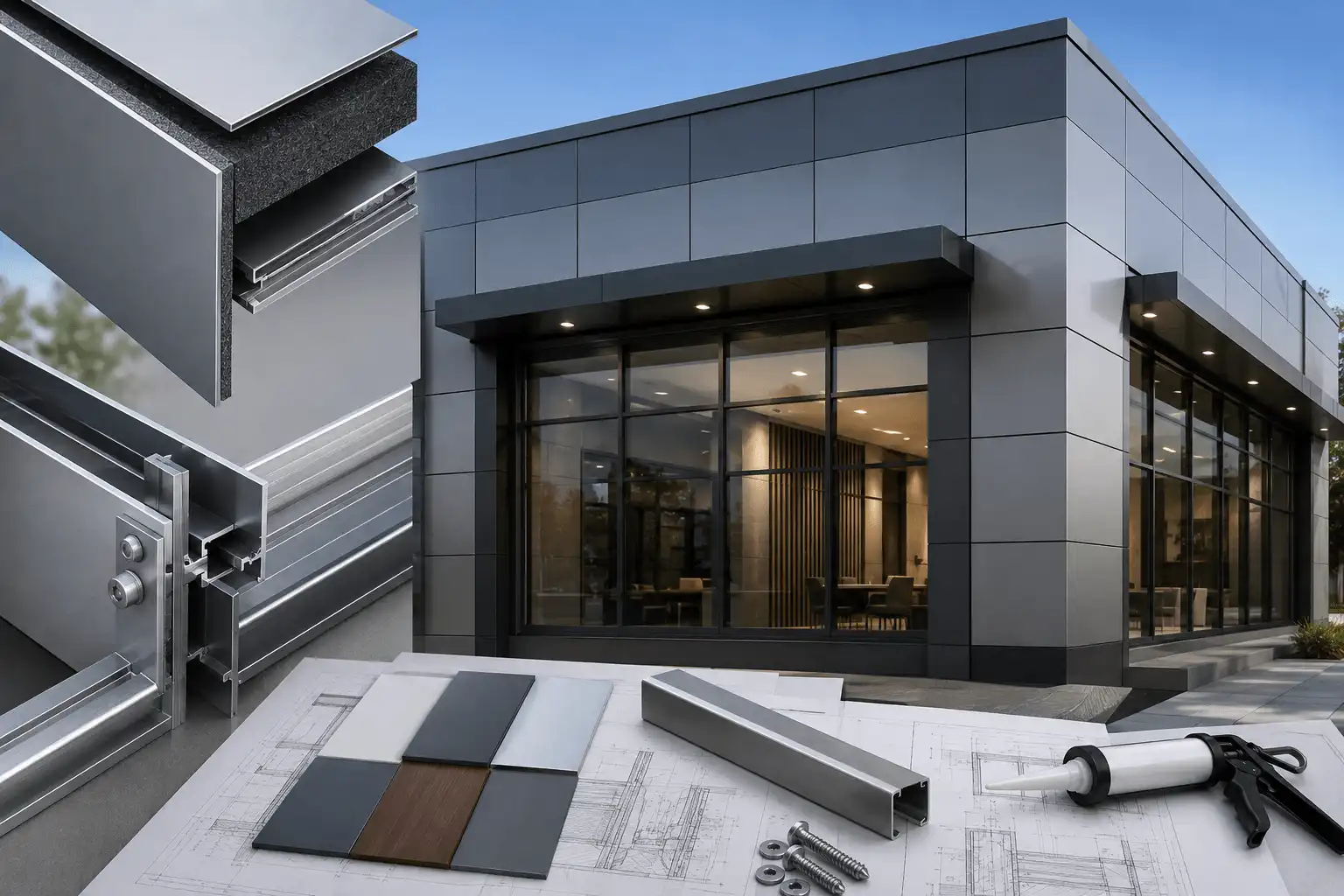
The material most closely associated with this change is Aluminium Composite Panel, commonly referred to in the trade simply as ACP. It consists of two thin sheets of aluminium bonded to either side of a non-aluminium core — typically a polymer, though fire-rated (FR) and fire-resistant (A2/A1) cores are now standard specifications for commercial and high-rise projects following stricter fire-safety norms adopted across Indian cities in recent years. The panels can be cut, folded and finished to resemble brushed metal, stone, wood grain or a flat painted surface, and they weigh a fraction of what an equivalent stone or masonry cladding would.
That combination — low weight, high design flexibility, and relatively fast fabrication — is why architects and contractors describe ACP not as a decorative afterthought but as a structural-adjacent material: one that lets a building’s elevation be redesigned without the cost or disruption of altering the building’s underlying structure.
Three factors, in particular, are repeatedly cited by architects and façade contractors working across Tamil Nadu’s commercial corridor:
- Weight and structural load. Because ACP panels are considerably lighter than tile, stone or brick veneer, they place minimal additional load on a building’s structure — a significant consideration for renovation projects on older buildings not originally engineered for heavy cladding.
- Fabrication speed. ACP can be pre-cut and finished off-site, then installed on a supporting frame, which shortens on-site construction time compared with masonry-based finishes. For businesses working to an opening date, this has a direct commercial value.
- Weather performance. Exterior-grade ACP, when properly specified, is engineered to resist UV degradation, colour fade and moisture ingress — a material property that matters considerably in a state where buildings face sustained heat, a prolonged monsoon, high humidity, and, in urban centres, dust and pollution.
It is worth noting, however, that not all ACP Sheet is equal. Panel quality varies significantly by coating type (PVDF coatings generally outperform standard polyester coatings in UV and colour retention), core composition, and aluminium skin thickness — variables that affect both the panel’s fire performance and its multi-year appearance. Businesses evaluating ACP cladding are, in effect, evaluating a specification, not just a material category.
From single product to coordinated system
For a period through the 2010s, CNC-cut decorative panels — laser-cut aluminium or MS sheets applied in geometric or floral patterns — represented the leading edge of commercial façade design in Tamil Nadu, and they remain widely used today. But contractors in the space describe a more significant shift in recent years: away from treating cladding, signage and lighting as separate, sequentially purchased items, and towards commissioning them as a single, coordinated exterior system.
“Ten years ago, a business would buy ACP sheets from one vendor and a signboard from another, often without either side knowing what the other was building,” said a representative of Galaxy Facade, a Tamil Nadu-based firm that designs and fabricates commercial exteriors. “What clients are asking for now is different — they want the cladding, the entrance glazing, the signage and the lighting planned together from the start, so the building reads as one identity rather than a collection of separately sourced parts.”
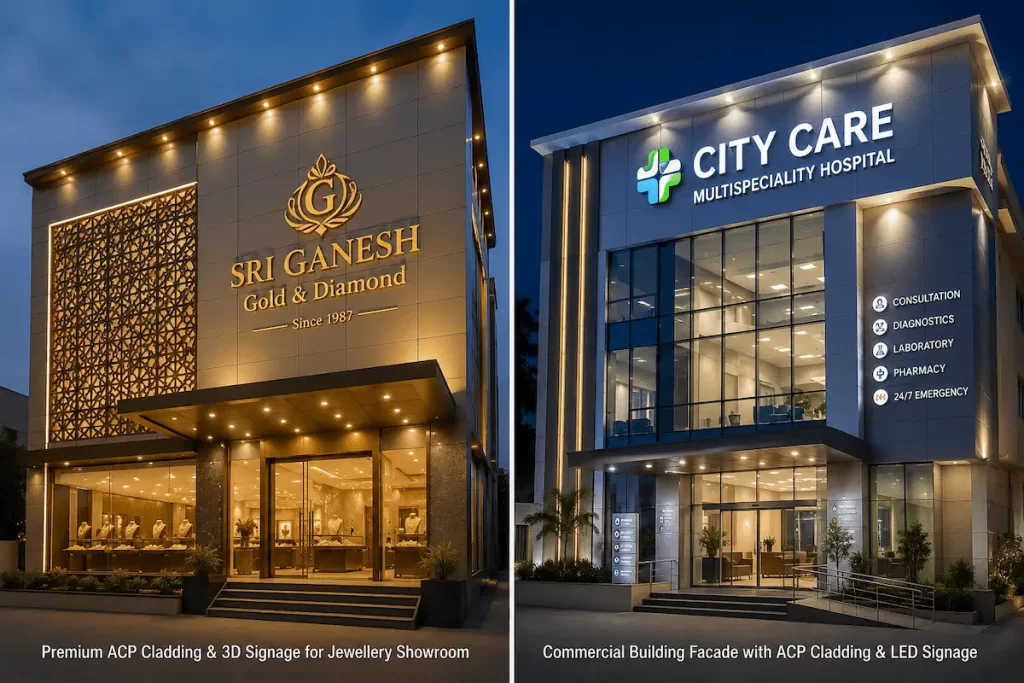
A typical integrated commercial façade specified today may combine:
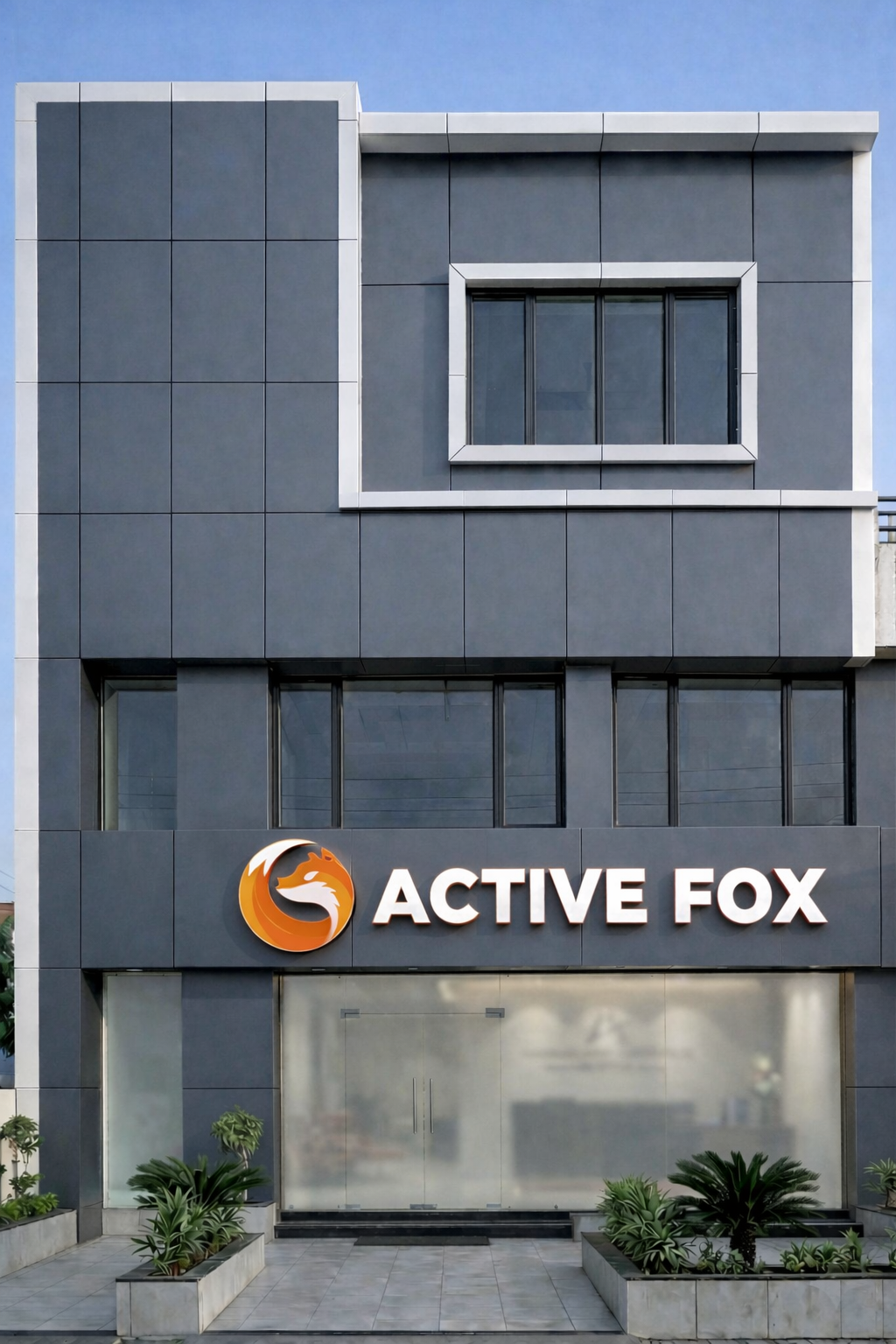
- ACP cladding as the primary elevation material
- Structural glass glazing at the entrance, for openness and daylight
- CNC-cut decorative panels for architectural texture and depth
- Aluminium Trimcap channel letters for illuminated, three-dimensional signage
- Architectural LED lighting, calibrated so the building remains visually distinct after dark
None of these elements is new individually. What has changed is the expectation that they be designed together, with a single visual and structural logic governing the building’s appearance in daylight and after sunset alike.
How ACP compares with the alternatives
No single material is correct for every project, and façade decisions are ultimately governed by budget, building type, and local regulatory requirements (including, increasingly, fire-safety clearances for cladding on buildings above a certain height). That said, industry comparisons of the commonly used commercial exterior finishes generally converge on a similar picture:
| Consideration | ACP Cladding | Exterior Paint | Exterior Tiles | Structural Glass |
|---|---|---|---|---|
| Contemporary appearance | Strong | Moderate | Fair to good | Strong |
| Contribution to brand visibility | Strong, especially with signage | Limited | Moderate | Strong, with signage |
| Weather resistance | Strong (with FR-grade core) | Moderate | Good | Strong |
| Maintenance burden | Low | High | Medium | Low |
| Design flexibility | High | Limited | Medium | Moderate to high |
| Installation speed | Fast | Fast | Slow | Medium |
| Typical fire safety consideration | Requires FR/A2-rated core for high-rise use | Not applicable | Not applicable | Requires tempered/laminated glazing |
| Long-term lifecycle value | Strong | Moderate | Good | Strong |
Read carefully, the table does not argue that ACP should replace glass or tiling outright — in practice, most well-designed commercial buildings use more than one of these materials in combination. It does help explain why ACP has increasingly become the material around which the others are arranged: it offers much of the durability of glass, with considerably greater flexibility of finish, at a faster installation timeline than tiled alternatives.
The economics: why lower maintenance changes the calculation
Business owners evaluating façade options often focus on upfront cost, which understandably favours paint — a coat of exterior emulsion is, on a per-square-foot basis, cheaper than any cladding system. But contractors and facilities managers point to a different metric: lifecycle cost, or the total expense of maintaining a given appearance over, say, a ten-year period.
Painted exteriors in Tamil Nadu’s climate typically require repainting every three to five years to maintain a presentable appearance, factoring in fading from UV exposure and staining from monsoon runoff and urban pollution — each cycle carrying not just material and labour cost but the operational disruption of scaffolding and, in retail environments, a less attractive storefront during the work. Exterior-grade ACP, by contrast, is generally understood to require little beyond periodic cleaning to retain its finish, pushing any significant refurbishment well beyond that window. Over a decade, the gap in total cost between the two options narrows considerably, and in some cases reverses, even though ACP’s initial outlay is higher.
This is the calculation that has moved façade decisions out of pure aesthetics and into the realm of capital planning — a shift reflected in how architects now present cladding options to clients, alongside projected maintenance schedules rather than as a standalone design choice.
Which industries are driving this shift
The move towards integrated, cladding-led commercial exteriors is not confined to any single sector. It is most visible, however, across categories where either customer trust or brand differentiation plays an outsized role in the purchase decision:
- Gold and jewellery showrooms
- Textile and apparel retail
- Mobile phone and electronics stores
- Hospitals and healthcare facilities
- Hotels and restaurants
- Supermarkets and hypermarkets
- Automobile dealerships and showrooms
- Shopping complexes and mixed-use developments
- Corporate office buildings
- Educational institutions
Each category brings distinct requirements to the same underlying system. A jewellery showroom typically prioritises a sense of security and luxury, often achieved through darker metallic ACP tones combined with restrained, high-contrast signage. A hospital tends towards lighter finishes and glass, signalling cleanliness and accessibility. A restaurant or hospitality project more often layers warm-toned lighting with textured CNC detailing to create ambience rather than pure visibility. The material palette is shared; the design language applied to it is not.
What this means for contractors — and for business owners choosing one
The shift towards integrated façade systems has changed what businesses reasonably expect from the firms they hire. Where façade work was once a matter of sourcing and fitting individual products — a cladding contractor here, a signage fabricator there — the more capable firms in this space now function closer to design consultancies: assessing a client’s industry, its target customer, and the building’s existing architecture before a single panel is cut or a lighting plan is drawn.
That distinction matters in practice. A façade system designed without reference to a hospital’s need for clear wayfinding, or a jewellery showroom’s need for controlled, secure entry points, tends to look coordinated on day one and function poorly thereafter. Firms with cross-disciplinary experience — spanning cladding fabrication, signage engineering and architectural lighting — are, on the available evidence, better placed to avoid that gap than vendors specialising in a single component.
A note on due diligence
Business owners evaluating façade proposals would do well to ask a small number of specific questions before committing: what fire-rating core is specified for the ACP panels, given increasingly strict municipal requirements for cladding on multi-storey commercial buildings; what coating grade is used, since PVDF-coated panels typically retain colour significantly longer than standard polyester-coated alternatives; and what warranty, if any, covers panel discolouration or delamination over time. These are not marketing details — they are the specifications that determine whether a façade still looks acceptable in year seven, not merely on the day of installation.
The bottom line
Whether the shift towards integrated, cladding-led commercial exteriors represents a lasting change in how Tamil Nadu’s businesses are built, or simply the current phase of an ongoing competition for customer attention, is a question the market will continue to answer over the coming years. What the evidence so far suggests is more modest, but still notable: for a growing number of businesses across retail, healthcare and hospitality, the building’s exterior has stopped being the last item finalised in a construction budget and has become one of the first questions asked at the design stage.
For business owners weighing a new build or a renovation, that suggests a practical starting point: rather than pricing cladding, signage and lighting separately, it may be worth having an initial conversation with a firm capable of assessing all three together — since it is the coordination between them, as much as any single material, that determines whether a façade still serves the business well a decade on. Galaxy Facade, among other firms operating in this space across Tamil Nadu, offers this kind of consultation for businesses at the planning stage of a commercial project.
As competition intensifies across retail, healthcare, hospitality and corporate real estate, businesses are treating the building exterior as a strategic asset rather than a construction afterthought — and Aluminium Composite Panel cladding has emerged as the material around which this shift is being built.
For most of the last half-century, the front of a commercial building in Tamil Nadu followed a familiar, largely unremarkable script: a painted wall, a flex banner strung above the entrance, perhaps a metal nameplate identifying the establishment within. It was cheap, it was functional, and it was almost entirely interchangeable from one shopfront to the next. Walk down a commercial street in Madurai, Coimbatore or Tiruchirappalli today, however, and that script is visibly being rewritten. Jewellery showrooms clad in metallic composite panels sit beside hospitals with glass-fronted entrances and illuminated signage; textile retailers commission façades intended to be photographed as much as walked past.
This is not simply a matter of aesthetics catching up with ambition. It reflects a more fundamental change in how business owners think about the building itself — not as overhead, but as the first and most persistent point of contact a brand has with its customer.
Why the exterior has become a business decision, not just a design one
Retail psychology has established, over decades of study, that customers form judgments about a business well before they interact with a single product or staff member. That principle has always been true; what has changed is the extent to which businesses in competitive, trust-sensitive categories — jewellery, healthcare, textiles, premium hospitality — are willing to act on it.
Consider the logic from a business owner’s point of view. A gold jewellery showroom is, at its core, selling confidence as much as carats. A private hospital is selling reassurance before it delivers treatment. A restaurant is selling an experience before the first plate ever reaches the table. In each of these cases, an exterior that looks dated, faded or improvised undercuts the very impression the business is trying to create — irrespective of the quality of what lies inside.
There is also a simpler, more measurable driver: visibility. On commercial roads crowded with competing establishments, a distinctive, well-lit façade can be the difference between a passing customer noticing a business and driving past it. In a market where walk-in footfall still accounts for a meaningful share of retail sales even as e-commerce grows, that visibility has a direct, if difficult to isolate, effect on revenue.
Taken together, these pressures explain why the commercial façade has moved from being a line item under “maintenance” to a line item under “brand investment” in the way many businesses now plan their budgets.
The material behind the shift: what ACP cladding actually is, and why it matters
The material most closely associated with this change is Aluminium Composite Panel, commonly referred to in the trade simply as ACP. It consists of two thin sheets of aluminium bonded to either side of a non-aluminium core — typically a polymer, though fire-rated (FR) and fire-resistant (A2/A1) cores are now standard specifications for commercial and high-rise projects following stricter fire-safety norms adopted across Indian cities in recent years. The panels can be cut, folded and finished to resemble brushed metal, stone, wood grain or a flat painted surface, and they weigh a fraction of what an equivalent stone or masonry cladding would.
That combination — low weight, high design flexibility, and relatively fast fabrication — is why architects and contractors describe ACP not as a decorative afterthought but as a structural-adjacent material: one that lets a building’s elevation be redesigned without the cost or disruption of altering the building’s underlying structure.
Three factors, in particular, are repeatedly cited by architects and façade contractors working across Tamil Nadu’s commercial corridor:
- Weight and structural load. Because ACP panels are considerably lighter than tile, stone or brick veneer, they place minimal additional load on a building’s structure — a significant consideration for renovation projects on older buildings not originally engineered for heavy cladding.
- Fabrication speed. ACP can be pre-cut and finished off-site, then installed on a supporting frame, which shortens on-site construction time compared with masonry-based finishes. For businesses working to an opening date, this has a direct commercial value.
- Weather performance. Exterior-grade ACP, when properly specified, is engineered to resist UV degradation, colour fade and moisture ingress — a material property that matters considerably in a state where buildings face sustained heat, a prolonged monsoon, high humidity, and, in urban centres, dust and pollution.
It is worth noting, however, that not all ACP is equal. Panel quality varies significantly by coating type (PVDF coatings generally outperform standard polyester coatings in UV and colour retention), core composition, and aluminium skin thickness — variables that affect both the panel’s fire performance and its multi-year appearance. Businesses evaluating ACP cladding are, in effect, evaluating a specification, not just a material category.
From single product to coordinated system
For a period through the 2010s, CNC-cut decorative panels — laser-cut aluminium or MS sheets applied in geometric or floral patterns — represented the leading edge of commercial façade design in Tamil Nadu, and they remain widely used today. But contractors in the space describe a more significant shift in recent years: away from treating cladding, signage and lighting as separate, sequentially purchased items, and towards commissioning them as a single, coordinated exterior system.
“Ten years ago, a business would buy ACP sheets from one vendor and a signboard from another, often without either side knowing what the other was building,” said a representative of Galaxy Facade, a Tamil Nadu-based firm that designs and fabricates commercial exteriors. “What clients are asking for now is different — they want the cladding, the entrance glazing, the signage and the lighting planned together from the start, so the building reads as one identity rather than a collection of separately sourced parts.”
A typical integrated commercial façade specified today may combine:
- ACP cladding as the primary elevation material
- Structural glass glazing at the entrance, for openness and daylight
- CNC-cut decorative panels for architectural texture and depth
- Aluminium Trimcap channel letters for illuminated, three-dimensional signage
- Architectural LED lighting, calibrated so the building remains visually distinct after dark
None of these elements is new individually. What has changed is the expectation that they be designed together, with a single visual and structural logic governing the building’s appearance in daylight and after sunset alike.
How ACP compares with the alternatives
No single material is correct for every project, and façade decisions are ultimately governed by budget, building type, and local regulatory requirements (including, increasingly, fire-safety clearances for cladding on buildings above a certain height). That said, industry comparisons of the commonly used commercial exterior finishes generally converge on a similar picture:
| Consideration | ACP Cladding | Exterior Paint | Exterior Tiles | Structural Glass |
|---|---|---|---|---|
| Contemporary appearance | Strong | Moderate | Fair to good | Strong |
| Contribution to brand visibility | Strong, especially with signage | Limited | Moderate | Strong, with signage |
| Weather resistance | Strong (with FR-grade core) | Moderate | Good | Strong |
| Maintenance burden | Low | High | Medium | Low |
| Design flexibility | High | Limited | Medium | Moderate to high |
| Installation speed | Fast | Fast | Slow | Medium |
| Typical fire safety consideration | Requires FR/A2-rated core for high-rise use | Not applicable | Not applicable | Requires tempered/laminated glazing |
| Long-term lifecycle value | Strong | Moderate | Good | Strong |
Read carefully, the table does not argue that ACP should replace glass or tiling outright — in practice, most well-designed commercial buildings use more than one of these materials in combination. It does help explain why ACP has increasingly become the material around which the others are arranged: it offers much of the durability of glass, with considerably greater flexibility of finish, at a faster installation timeline than tiled alternatives.
The economics: why lower maintenance changes the calculation
Business owners evaluating façade options often focus on upfront cost, which understandably favours paint — a coat of exterior emulsion is, on a per-square-foot basis, cheaper than any cladding system. But contractors and facilities managers point to a different metric: lifecycle cost, or the total expense of maintaining a given appearance over, say, a ten-year period.
Painted exteriors in Tamil Nadu’s climate typically require repainting every three to five years to maintain a presentable appearance, factoring in fading from UV exposure and staining from monsoon runoff and urban pollution — each cycle carrying not just material and labour cost but the operational disruption of scaffolding and, in retail environments, a less attractive storefront during the work. Exterior-grade ACP, by contrast, is generally understood to require little beyond periodic cleaning to retain its finish, pushing any significant refurbishment well beyond that window. Over a decade, the gap in total cost between the two options narrows considerably, and in some cases reverses, even though ACP’s initial outlay is higher.
This is the calculation that has moved façade decisions out of pure aesthetics and into the realm of capital planning — a shift reflected in how architects now present cladding options to clients, alongside projected maintenance schedules rather than as a standalone design choice.
Which industries are driving this shift
The move towards integrated, cladding-led commercial exteriors is not confined to any single sector. It is most visible, however, across categories where either customer trust or brand differentiation plays an outsized role in the purchase decision:
- Gold and jewellery showrooms
- Textile and apparel retail
- Mobile phone and electronics stores
- Hospitals and healthcare facilities
- Hotels and restaurants
- Supermarkets and hypermarkets
- Automobile dealerships and showrooms
- Shopping complexes and mixed-use developments
- Corporate office buildings
- Educational institutions
Each category brings distinct requirements to the same underlying system. A jewellery showroom typically prioritises a sense of security and luxury, often achieved through darker metallic ACP tones combined with restrained, high-contrast signage. A hospital tends towards lighter finishes and glass, signalling cleanliness and accessibility. A restaurant or hospitality project more often layers warm-toned lighting with textured CNC detailing to create ambience rather than pure visibility. The material palette is shared; the design language applied to it is not.
What this means for contractors — and for business owners choosing one
The shift towards integrated façade systems has changed what businesses reasonably expect from the firms they hire. Where façade work was once a matter of sourcing and fitting individual products — a cladding contractor here, a signage fabricator there — the more capable firms in this space now function closer to design consultancies: assessing a client’s industry, its target customer, and the building’s existing architecture before a single panel is cut or a lighting plan is drawn.
That distinction matters in practice. A façade system designed without reference to a hospital’s need for clear wayfinding, or a jewellery showroom’s need for controlled, secure entry points, tends to look coordinated on day one and function poorly thereafter. Firms with cross-disciplinary experience — spanning cladding fabrication, signage engineering and architectural lighting — are, on the available evidence, better placed to avoid that gap than vendors specialising in a single component.
A note on due diligence
Business owners evaluating façade proposals would do well to ask a small number of specific questions before committing: what fire-rating core is specified for the ACP panels, given increasingly strict municipal requirements for cladding on multi-storey commercial buildings; what coating grade is used, since PVDF-coated panels typically retain colour significantly longer than standard polyester-coated alternatives; and what warranty, if any, covers panel discolouration or delamination over time. These are not marketing details — they are the specifications that determine whether a façade still looks acceptable in year seven, not merely on the day of installation.
The bottom line
Whether the shift towards integrated, cladding-led commercial exteriors represents a lasting change in how Tamil Nadu’s businesses are built, or simply the current phase of an ongoing competition for customer attention, is a question the market will continue to answer over the coming years. What the evidence so far suggests is more modest, but still notable: for a growing number of businesses across retail, healthcare and hospitality, the building’s exterior has stopped being the last item finalised in a construction budget and has become one of the first questions asked at the design stage.
For business owners weighing a new build or a renovation, that suggests a practical starting point: rather than pricing cladding, signage and lighting separately, it may be worth having an initial conversation with a firm capable of assessing all three together — since it is the coordination between them, as much as any single material, that determines whether a façade still serves the business well a decade on. Galaxy Facade, among other firms operating in this space across Tamil Nadu, offers this kind of consultation for businesses at the planning stage of a commercial project.