Almost every client asks the same question first when it comes to ACP Cladding Specification: “3mm or 4mm, which one should I go for?” And usually someone has already told them a different answer. One vendor says 3mm is fine. Another says only 4mm is “proper quality.” A third just quotes whatever is cheapest and doesn’t explain why.
The truth is both are used all the time in Tamil Nadu. The right one depends on the building, not on which vendor you spoke to last. And thickness is only one part of the picture. Aluminium skin, core, coating, framework, fabrication, sealant, installation — all of it decides how the final facade actually looks and holds up.
What Is ACP Cladding, In Simple Words
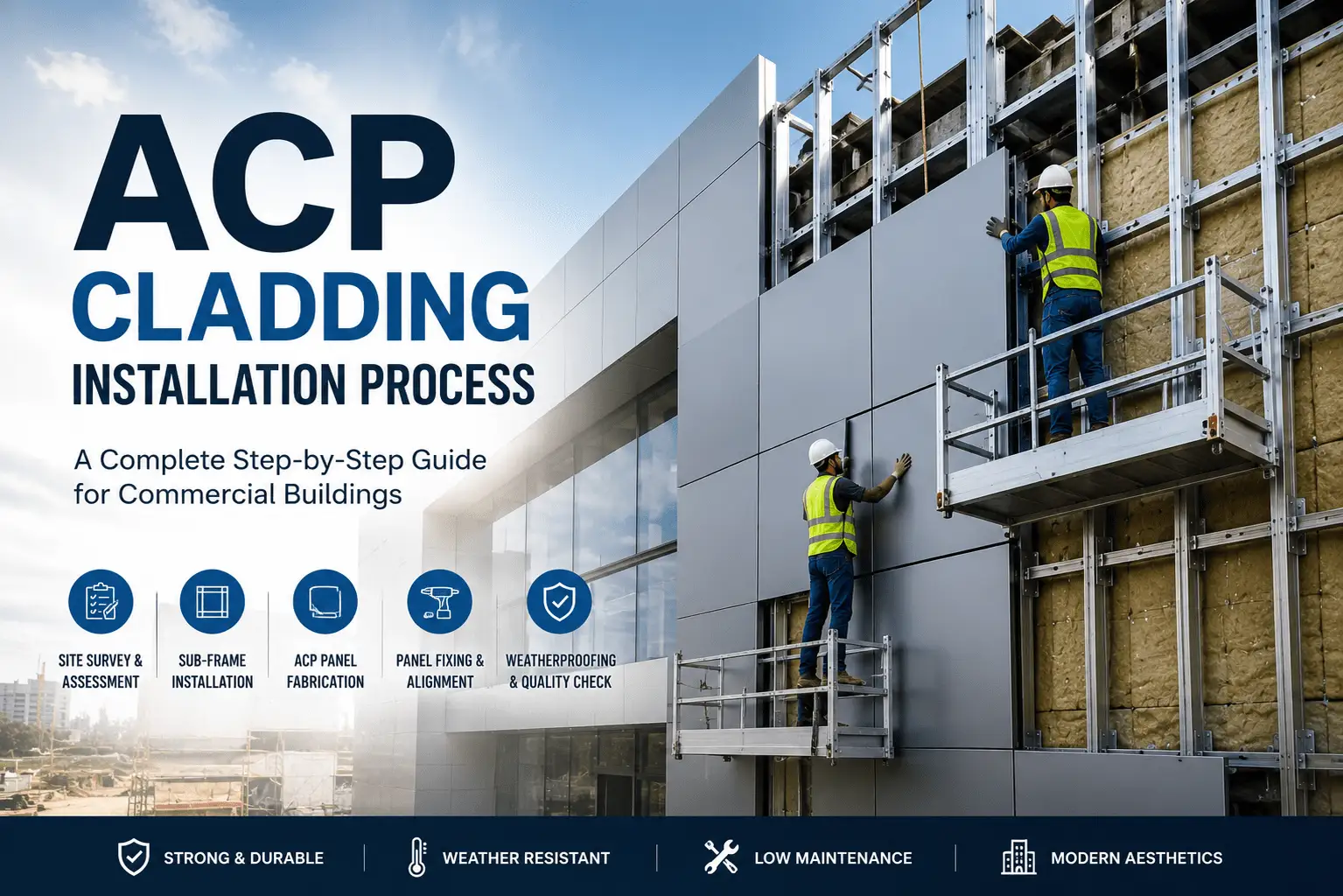
ACP stands for Aluminium Composite Panel. Two thin aluminium sheets with a core material pressed in between. That’s the sheet. But on a building, ACP is never just a sheet stuck on a wall.
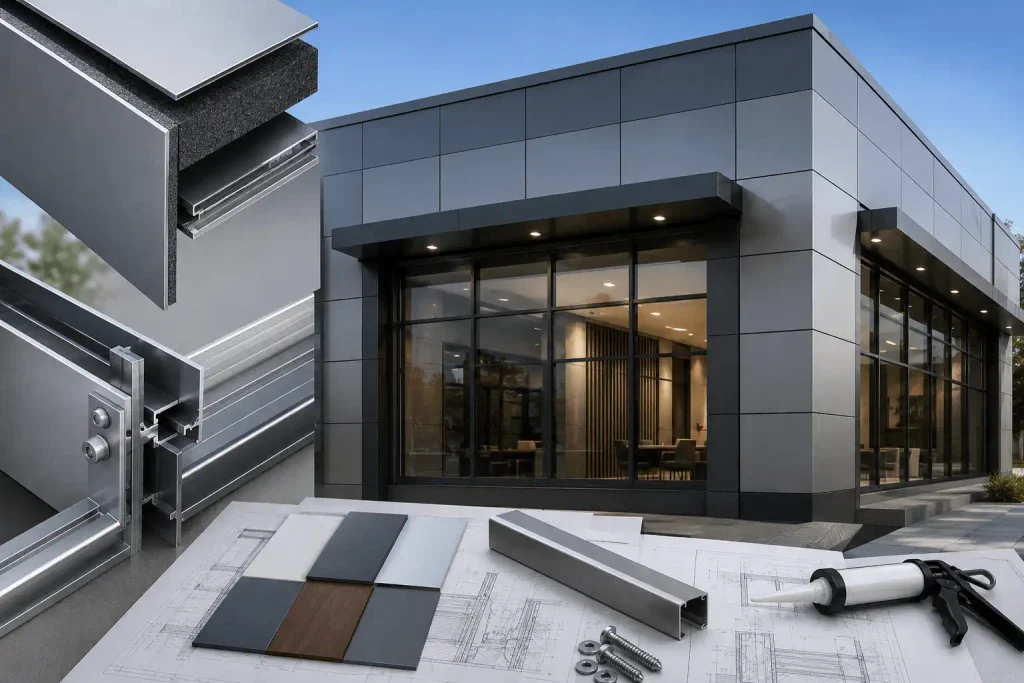
Think of it as a system: the panel, the aluminium framework behind it, the way it’s routed and folded, the joints, the sealant, and the person actually fixing it on site. Change any one part and the whole facade changes with it. We’ve seen the same ACP brand look excellent on one building and average on another — same sheet, different fabrication team.
ACP is usually combined with glass, aluminium trims, and signage lighting to build the complete elevation. A showroom front is a good example — glass for the display area, ACP for the solid sections, LED signage on top.
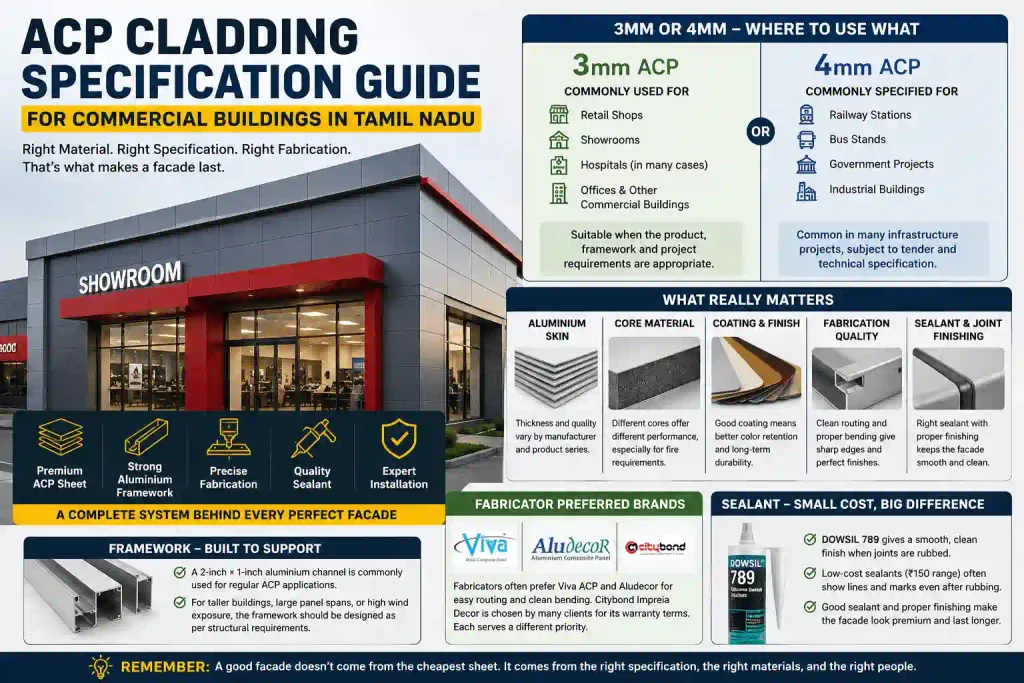
3mm or 4mm — Where to Use What
Here’s the practical answer, based on what we actually specify on real jobs:
Retail shops and showrooms — 3mm is usually enough. It’s lighter, easier to fabricate, and does the job well for most shopfronts and showroom elevations. We did a textile showroom in Madurai last year on 3mm ACP with glass glazing, and it’s held up fine.
Hospitals — 3mm works in many cases too, especially on entrance canopies and feature walls. But hospital projects sometimes come with their own fire or durability clause in the drawing. Always check the spec before assuming 3mm is fine.
Railway stations, bus stands, government and industrial buildings — mostly 4mm, and mostly because the tender says so. These jobs come with fixed technical specifications, and 4mm is what gets called for in most of them.
Whatever the general trend is, the final ACP Cladding Specification should always follow the tender document and consultant drawings. Not market opinion, not the lowest quote. If the tender says 4mm with a specific core, that’s what goes on the building — full stop.
Why Thickness Alone Doesn’t Tell You Enough
Two sheets can both say “4mm” and still be completely different products. The aluminium skin thickness, the core material inside, and the coating can all vary between manufacturers — even between two product lines from the same manufacturer.
So don’t just ask “is it 4mm ACP.” Ask for the manufacturer name and the exact product series. That’s the only way to actually compare two quotations properly.
Coating and Finish
ACP comes in solid colours, metallic finishes, wood-look, and stone-look. Clients usually pick based on branding or how it matches the building next door, which is fine. But in Tamil Nadu’s climate — strong sun most of the year, heavy rain in some districts — the coating quality matters more than people realise. A poor coating fades or chalks within a couple of years, especially on dark colours facing direct sun. Ask about the coating system and warranty, not just the shade card.
Fabrication — Routing, Grooving, Bending
This is where the finish actually gets decided. The sheet gets routed, grooved, and folded to make corners, returns, and box sections.
From our own fabrication experience, sheets like Viva ACP and Aludecor are easier to route. You get a cleaner fold, and the routing line doesn’t show on the visible face when the cut is done right. That’s a real, noticeable difference on site, not just a brand preference.
But the ACP Cladding Specification also depends heavily on the fabricator. If the routing is cut too deep, the fold can crack or show a visible line right at the bend — even on a good sheet. We’ve seen this happen with less experienced teams: routing depth was wrong, and the corner fold cracked during bending. So a good sheet still needs a fabricator who knows what they’re doing.
Warranty vs Fabrication — Two Different Questions
Some clients specifically ask for Citybond, Impreia Decor because of its warranty terms. Others ask for Viva ACP or Aludecor because they’re easier to fabricate and give a cleaner bend. These are two separate points, and one doesn’t cancel the other out. A product with a longer warranty isn’t automatically easier to work with, and a product that’s easy to route isn’t automatically the one with the best warranty. Decide based on what actually matters for your project — long-term coverage, or fabrication finish, or both.
Framework — What’s Holding the Panel Up
Most fabricators use a 2-inch × 1-inch aluminium channel for regular ACP work. It’s the standard size for shopfronts and normal commercial elevations.
For bigger buildings — taller elevations, larger panel spans, higher wind exposure — this channel size isn’t enough on its own. The framework needs to be designed properly, based on wind load and structural calculations, not copied from a smaller job.
Joints and Finishing — Where Mistakes Show First
Accurate measuring and cutting keep the joint lines straight across the whole elevation. This matters most around windows, doors, and signage boxes — any spot where the eye naturally stops and looks.
Get the measurement wrong here and it shows immediately. Gaps that aren’t even. Panel lines that don’t align with the window frame next to it. No amount of good ACP sheet fixes a joint that was cut wrong.
Sealant — Small Cost, Big Visible Impact
Sealant is a small part of the total cost, but it shows up big on the finished wall. Use a cheap sealant and, once you tool the joint, it often leaves visible smear marks or a rough line — especially bad on dark-coloured panels where every mark stands out.
Dowsil 789 is preferred by many fabricators because it tools clean and gives a smooth finish. But it still needs to be checked for compatibility with the panel coating and adjacent materials before use — don’t assume it works everywhere just because it’s a known name.
ACP on Showrooms and Retail Shops
This is where ACP gets used the most, and where the ACP Cladding Specification really matters. Branding, signage, and appearance matter as much as budget here. 3mm ACP with glass and illuminated signage covers most of these jobs well. Because people stand close to these facades, fabrication quality shows up fast — clean corners and tight joints make the whole front look premium, even before anyone walks in.
ACP on Hospitals
Hospital facades usually go on entrance areas and feature walls, not the entire building. 3mm suits many of these projects, but always check if the drawing calls for a specific fire rating or durability spec. In one Tirunelveli hospital job we worked on, the entrance canopy needed a specific fire-rated core because of the consultant’s spec — a plain 3mm wouldn’t have passed.
ACP on Railway Stations and Bus Stands
Government infrastructure work runs on tender specifications, not general market practice. 4mm is common here because that’s what most tenders call for. Larger facade areas, heavier public use, and stricter material approvals are typical on these jobs. Confirm thickness, core, and fire rating from the actual tender document before fabrication starts.
ACP on Industrial Buildings
Industrial sites usually use ACP on office blocks and entrance areas, not the factory shed itself. What’s needed depends on building height, exposure, and the design brief. Get the product approved before fabrication — changing material mid-project costs far more than getting it right at the start.
ACP with Structural Glazing
ACP and glass are often combined — glass for entrances and display windows, ACP for the solid sections. Where the two meet, the framework, joints, and drainage detail need careful coordination. Get this wrong and water can find its way in at the junction over time.
How to Compare Quotations
Don’t compare quotations by the final number alone. Ask each contractor for the manufacturer, product series, panel thickness, aluminium skin, core, coating, framework type, sealant, and installation scope. One contractor might quote lower on the panel but leave out the framework or installation. Another might quote higher but include everything. Line up both quotes point by point — that’s the only fair comparison.
ACP Cladding Specification by Project Type
| Project Type | Common Thickness Used |
|---|---|
| Retail shops | 3mm |
| Showrooms | 3mm |
| Hospitals | 3mm, subject to spec |
| Commercial buildings | 3mm or 4mm, per design |
| Railway stations | 4mm |
| Bus stands | 4mm |
| Industrial facades | 4mm, per tender |
| Government projects | As per tender specification |
This table shows common practice. The tender and consultant drawing always decide the final thickness on any specific project.
If you also want to understand the typical materials and overall cost involved in an ACP cladding project, see our Complete ACP Cladding Materials & LED Signage Cost in Tamil Nadu guide. It covers the main materials and cost factors that can affect a project quotation.
Final Thoughts
As per a proper ACP Cladding Specification, ACP cladding is a system, not just a sheet. The panel, the framework, the fabrication, the sealant, and the installation team all decide how the finished building looks and how long it stays looking that way. Get the sheet right and the framework wrong, and the facade still fails. Get the sheet and framework right but the sealant cheap, and the joints still look bad in two years. A good contractor should explain all of this clearly in the quotation, not just quote a price per square foot.
Frequently Asked Questions
Is 3mm ACP enough for a showroom? Yes, in most cases. 3mm works well for showroom and retail elevations when the framework and installation are done properly.
Is 4mm ACP better than 3mm ACP? Not automatically better — just meant for different jobs. 4mm gets used where the tender or project spec asks for it, often on government and industrial work. 3mm covers most retail and commercial jobs well.
What thickness is used for railway stations? Mostly 4mm, because that’s what most railway and government tenders specify. Always confirm from the actual tender document.
What channel size is used for ACP framework? 2-inch × 1-inch aluminium channel for regular work. Bigger buildings need a different structure based on wind load and design.
Why do fabricators prefer certain ACP brands? Mainly because of how the sheet routes and bends. Viva ACP and Aludecor are known among fabricators for giving a cleaner fold without visible routing lines, though the fabricator’s skill still matters a lot.
Why does sealant matter so much? Because it affects how clean the joints look and how well the facade seals against weather. Cheap sealant leaves visible marks, especially on dark panels. Compatibility should always be checked before use.
Should ACP cladding be chosen on price alone? No. Thickness, brand, framework, sealant, and installation quality all affect the final result. Compare the full specification, not just the rate per square foot.