Technical review: November 2026
1. Why ACP Core Selection Matters
Ask a shop owner in Tenkasi or Nagercoil what he is putting on his new front, and the answer is almost always the same: u201cACP.u201d Then ask which ACP. Is it 3mm or 4mm? PE or FR? Most people go quiet, because nobody has told them, and the finished panel does not say it anywhere.
That is the real problem. People talk about u201cACP sheetu201d as if it is one product. It is not. Two panels can look exactly the same from outside and behave very differently in a fire.
We do ACP cladding and LED signage work for commercial buildings, so we get this question regularly: u201cAnna, which ACP should I use, PE or FR? Is 4mm better than 3mm?u201d The honest answer is that it depends on your building and your specification. This guide explains the core types, the fire classes, what panel thickness does and does not tell you, and how to read the test papers suppliers hand over, so you are not buying on a brochure alone.
This article deals with the product and its evidence. The Indian product standard, the model fire-safety guidance in NBCS 2026 and the installation side of the façade are covered separately in ACP cladding fire safety in India: IS 17682, NBCS 2026 and façade installation requirements.
2. How ACP Is Commonly Selected in Tamil Nadu
In our experience, three things decide which ACP gets used on a project:
- The owneru2019s budget and what he expects the elevation to look like.
- The specification given by the architect, engineer or consultant, if there is one.
- Tender conditions, fire-safety requirements and approvals.
What follows is how things commonly happen in the projects we see. It is field experience, not a statewide survey or a market statistic. Every project is different.
Commercial streets, shops and business buildings
A shop owner on a busy street wants a good-looking front at a price he can manage. The work usually goes to a local ACP contractor, and the quotation, the budget and the colour chosen end up deciding the material.
In many local shopfront projects we see, 3mm PE-core ACP is chosen as the economical option. It costs less, it is light, and it suits ordinary decorative shopfront work.
But PE-core ACP being commonly used does not mean it is suitable for every building. Whether it is acceptable depends on the buildingu2019s use, height, the fire rules that apply and the project specification.
Factories and industrial buildings
Large factories and industrial units usually buy differently. There are often architects, structural consultants, project engineers or a technical purchase team, a BOQ and a written material specification. Vendors have to submit documents and get approval. Because the material is selected through a specification and not on price alone, FR-grade ACP is more likely to be asked for here. Even then, an FR label alone does not prove that the whole façade is safe or compliant.
Government buildings and tender work
Government and government-contract projects can have stricter specifications. Depending on the individual tender, the document may specify 4mm ACP, a particular aluminium skin thickness, an FR grade, coating requirements and test certificates. But please do not assume every government job has the same requirement. The real requirement comes from the tender document, the approved drawings and the conditions of the authority. As a contractor, we follow what is approved, not what we think is usual.
So these are different situations and should not be mixed up:
- A normal shopfront.
- A factory or industrial specification.
- A government tender.
- A project with specific fire-authority conditions.
3. PE-Core ACP: Characteristics and Limitations
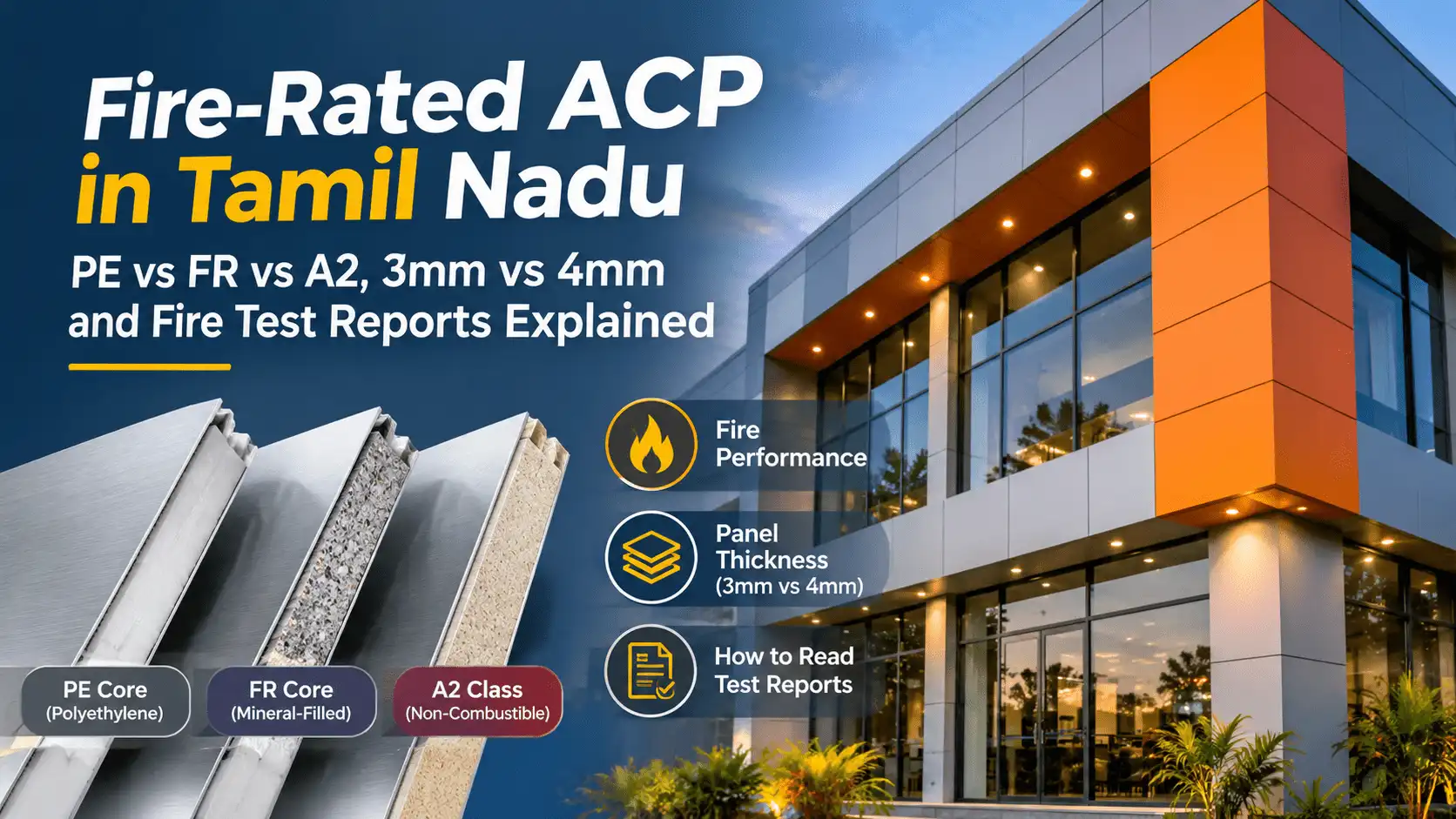
PE means polyethylene. A standard PE panel is two aluminium skins bonded to a polyethylene-based core. It is light, flat and comes in many colours and finishes, and it is usually the cheaper option. That is why, in our experience, we see many 3mm PE quotations for decorative façade work.
PE-core ACP is not fire-retardant just because it is called ACP. Polyethylene is a combustible plastic. A standard PE panel and a mineral-filled FR panel are not the same thing, and one cannot be swapped for the other. Indiau2019s ACP standard, IS 17682:2021, also says its LDPE-core grades should not be preferred for building façades. That is a selection note rather than a blanket ban; the details are in BIS ACP grades and their intended use.
If your project specification asks for FR grade or another tested classification, do not accept a PE panel just because the quotation is lower. A low quotation often does not tell you which core material is actually supplied, the panel thickness, the aluminium skin thickness, the coating type, the fire classification, or whether the material delivered matches the approved specification. u201cACP sheetu201d alone is not a material specification. Ask for the product datasheet and the grade name.
4. FR-Grade ACP: Mineral-Core Panels and Their Limitations
FR means fire retardant. These panels generally have a polymer core mixed with mineral fillers, so the panel contributes less to a fire than a standard PE panel does. In the Indian standard they are called mineral-core FR ACP.
But FR does not mean fireproof. How an FR panel performs depends on what is actually inside it, how well it is made, and what the test papers say about it. u201cFR gradeu201d is a description of the product. It is not a fire classification, and it does not tell you which test the product passed.
In our experience FR panels are more likely on factories and industrial buildings, large commercial facilities, institutional buildings, projects designed by architects and engineering consultants, and projects with specific tender or fire-safety conditions. It is not only because those buildings are bigger. It is because their approval process asks for technical papers, which a simple decorative ACP quotation often does not include.
5. 3mm vs 4mm ACP: What Thickness Actually Tells Buyers
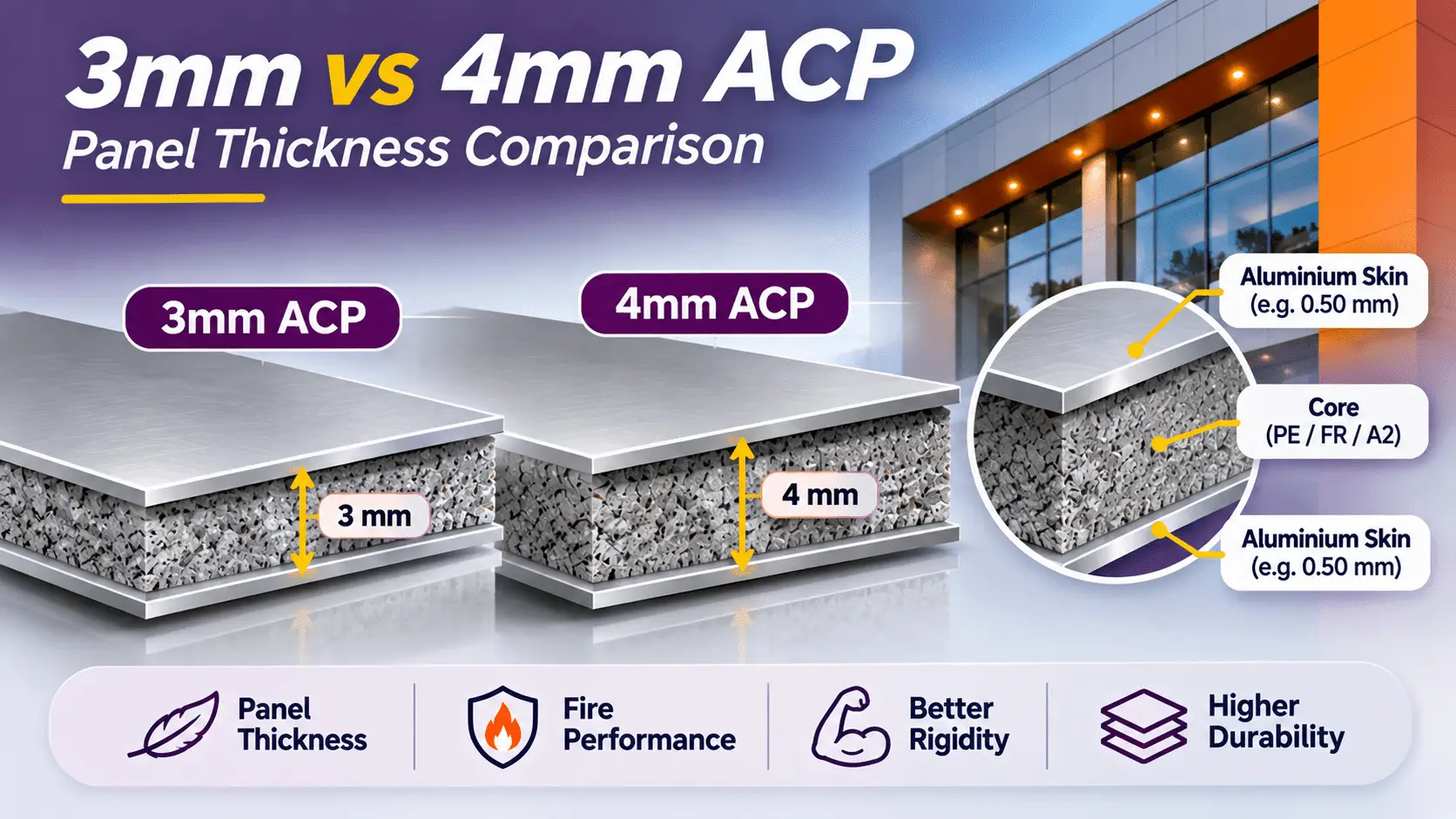
Thickness is only one line of the specification. A 4mm panel is not automatically better in fire than every 3mm panel, and 4mm does not mean u201cFRu201d. A 4mm sheet can have a PE-based core, a mineral-filled FR core or something else.
| Thickness tells you | Thickness does not tell you |
|---|---|
| The overall panel depth and, roughly, its stiffness and weight | Whether the core is PE or mineral-filled |
| Whether the panel matches the thickness in the specification or tender | The fire classification, or which test it was assessed under |
| One input to fabrication, fixing and flatness | The thickness of the aluminium skins, which is a separate figure |
Skin thickness is a good example. Two 4mm panels can have different aluminium skins: the VIVA 5 Star FR B1 datasheet we reviewed declares 0.25mm skins, while the CityBond CB-45 FR datasheet declares 0.50mm. Both are manufacturer declarations. Ask for panel thickness and skin thickness separately.
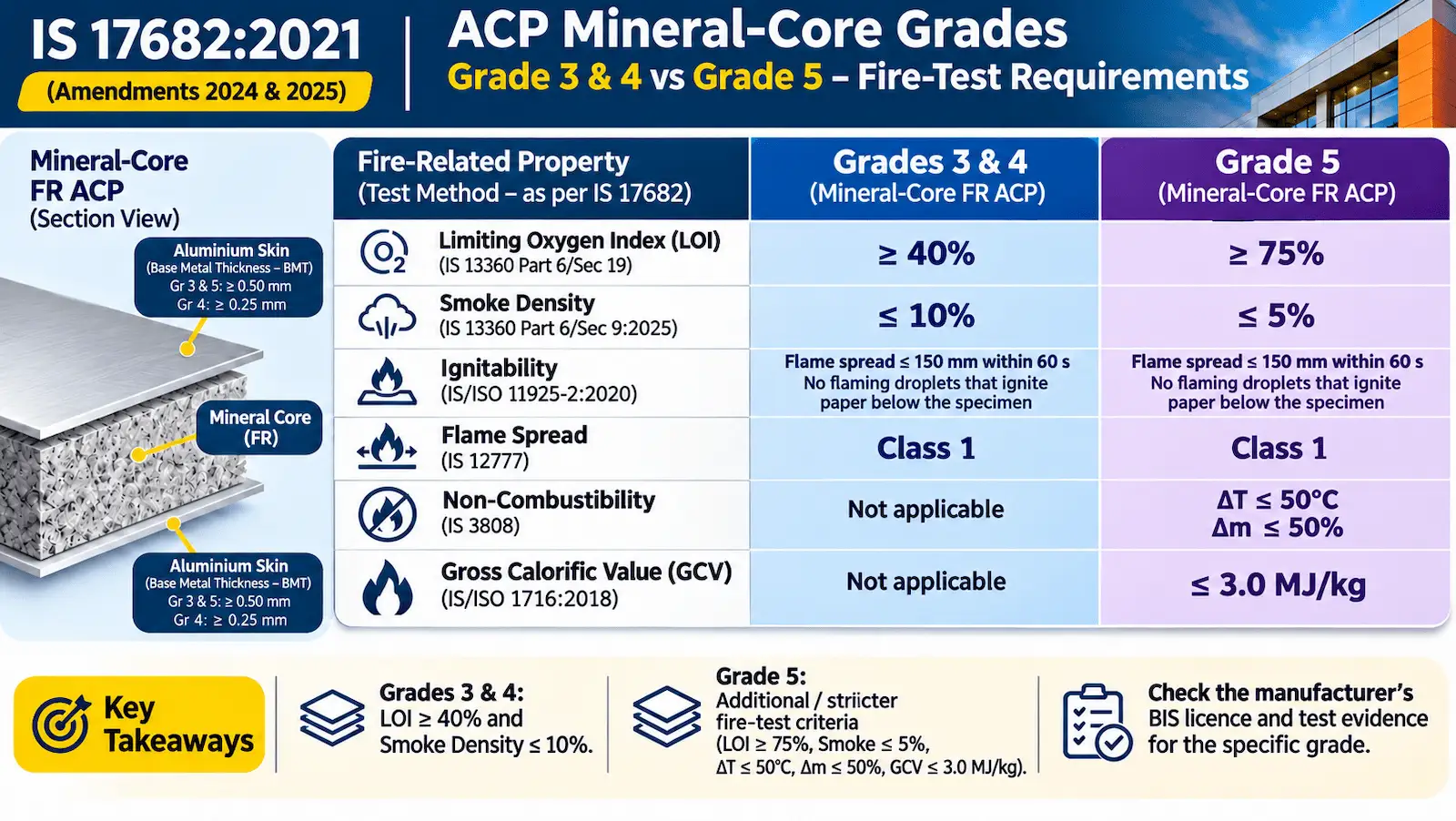
On the standards side, IS 17682 covers several nominal thicknesses, and only its Grade 5 (for high-rise and special buildings) carries a 4mm minimum. That does not make 4mm compulsory for every FR panel or every commercial or government project. The full thickness provisions are in BIS ACP grades and nominal thickness requirements. A tender may still ask for 4mm for its own reasons, so follow the approved specification.
6. PE vs FR vs A2: Technical Differences
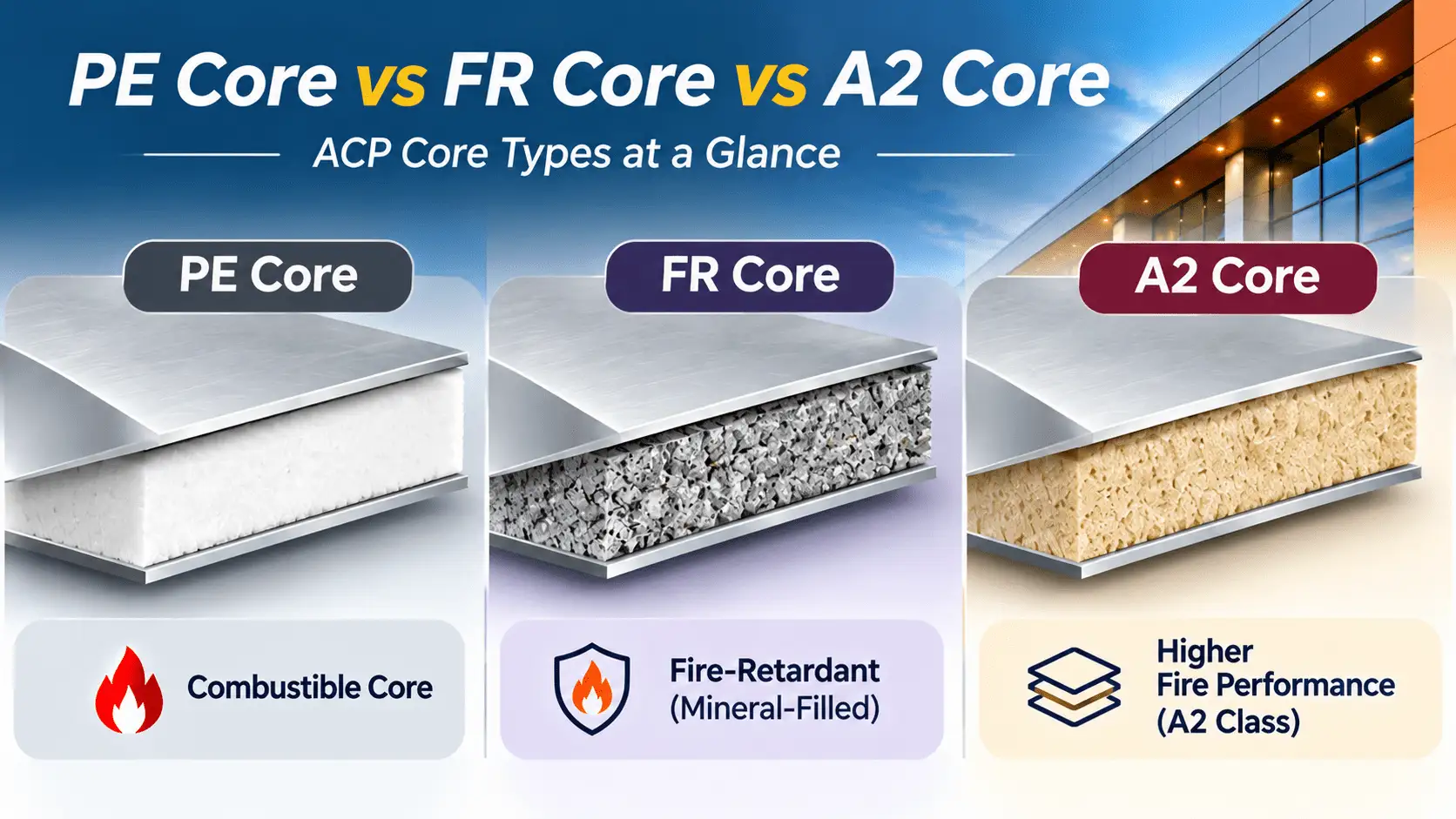
These three terms belong to different categories. PE and FR describe the core and character of the panel, that is, what it is made of. A2 is not a core type: it is a reaction-to-fire class under the European standard EN 13501-1, given to a product that has been tested and classified under that system. A panel can be sold as FR without being classified A2, so a search for u201cA2 fire-rated ACPu201d needs care: A2 describes reaction to fire, not a fire-resistance rating.
| Feature | Standard PE core | FR core | ACP classified A2 (EN 13501-1) |
|---|---|---|---|
| Core | Polyethylene-based polymer | Polymer with mineral fillers | Not a core type. How a panel reaches the class depends on its construction and test evidence |
| Fire behaviour | Combustible | Contributes less to fire than standard PE, depending on the product | Very limited contribution to fire under the applicable classification |
| Classification | Must be checked for the exact product | Product-specific test classification | Must be backed by the relevant A2 test result |
| Where it is usually considered | Budget-sensitive decorative work | Specification-driven commercial and industrial projects | Projects needing higher reaction-to-fire performance |
| Limitation to remember | Cannot replace FR | Not fireproof | A2 does not mean fire resistance, and does not mean the whole façade is tested |
A2 is not another word for u201cFRu201d and it is not another word for u201cfireproofu201d. Reaction to fire (how a product contributes to a fire) is a different idea from fire resistance (how long a building element keeps doing its job in a fire). An Indian BIS grade is a third, separate scheme, so compliance with a BIS grade does not by itself establish an A2 or B-s1,d0 classification. Look at the test standard and classification written in the manufactureru2019s actual report.
7. How to Read ACP Fire-Test Documents
A brochure, a Technical Data Sheet (TDS), a laboratory test report and a third-party product certificate are four different things. Do not treat them as the same.
| Document | Who speaks | What it can show | What to remember |
|---|---|---|---|
| Brochure | Manufacturer or seller | Marketing summary | Not evidence of performance |
| Technical Data Sheet | Manufacturer | Declared specifications | The manufacturer describing its own product; ask for the supporting report |
| Laboratory test report | Testing laboratory | Result for the sample, method and date stated | Applies to the tested sample and method only |
| Third-party certificate | Certifying or consulting body | A stated result or approval within a stated scope | Check scope, issue date and expiry |
For any document, ask the same five questions: which exact product was tested, which test was done, which standard was followed, what is the issue date and validity, and does the evidence cover only the panel or the whole façade.
8. EN 13501-1 Explained
This is the European reaction-to-fire system. The classes are A1, A2, B, C, D, E and F, with extra ratings for smoke and flaming droplets. In B-s1,d0, the B is the reaction-to-fire class, s1 is the smoke rating and d0 is the flaming-droplet rating. Reaction to fire describes how a product contributes to a fire. It is not a fire-resistance rating. Always read the full classification from the actual test report, not from a summary line in a brochure.
9. ASTM E84 Explained
ASTM E84 is a surface-burning test. It reports a Flame Spread Index and a Smoke Developed Index. A Class A result in ASTM E84 is not the same as A2 in EN 13501-1. The VIVA 6 Star FR certificate we reviewed reports an FSI of 15 and an SDI of 25 under ASTM E84-22. Describe it that way. Do not convert it into an EN class.
10. ASTM E119 Explained
ASTM E119 tests the fire resistance of building elements and assemblies. If a datasheet mentions two hours under E119, ask for the report and find out which assembly was tested. An ACP sheet by itself does not carry a two-hour fire-resistance rating just because a datasheet says so.
11. NFPA 285 and Large-Scale Façade Testing
NFPA 285 looks at fire propagation in specified exterior wall assemblies. The result applies only to the tested configuration. Change the insulation, the cladding, the cavity, the framing or the joint details, and the old result may no longer apply. A panel-level result, such as an EN 13501-1 class or an ASTM E84 index, is not a complete-façade result. The installation side of this, including cavities and fire stopping, is covered in ACP façade fire stopping and installation requirements.
The simple rule: ask which product was tested, which test was done, which standard was followed, and whether the evidence covers only the panel or the whole façade.
12. Review of the Supplied Unistone, VIVA and CityBond Documents
Below are five documents that were supplied to us while preparing this article. We use them only to show how to read product evidence. We summarise what each document says. We have not independently re-tested these products or confirmed the documents with the issuing laboratories. This is not a ranking of brands, and it does not say any product suits every building.
12.1 Unistone Panels: Shriram Institute test report, June 2025
Evidence type: laboratory test report. Issued by Shriram Institute for Industrial Research, Delhi.
- Client: Unistone Panels Pvt. Ltd.
- Sample description: ACP Sheet Class B.
- Test report number: C1/0000397732.
- Date of issue: 24 June 2025.
- Test method: EN 13501-1:2018.
- Reported result: Class B-s1,d0.
One sample was received and tested for the flame retardant test, and the result is Class B-s1,d0 under the stated protocol. This gives you test evidence for that sample and that result. It does not tell you how every Unistone product, every thickness or a complete installed façade will behave. Match the product series, the batch and the specification with the report before you buy.
12.2 Unistone Panels: earlier FR test certificate, January 2019
Evidence type: laboratory certificate, older. Issued by Shriram Institute.
- Client: Unistone Panels Pvt. Ltd.
- Sample: ACP Type FR, 3mm x 0.25 (solid).
- Certificate number: C1/0000158840.
- Date: 28 January 2019.
- Flammability: the sample self-extinguished after the flame was removed.
- Melting behaviour: no drop formed that ignited the cotton wool.
- Resistance to spread of flame: Class A under the stated method.
- Deterioration of visibility due to smoke: Class A under the stated method.
The tests refer to IS 15061:2002 and UIC 564-2. The document also notes that the vertical burning and melting-behaviour tests were outside NABL scope. This is an old certificate using the methods written in it. Do not present it as proof of a current EN 13501-1 classification, and do not use it in place of current product-specific certification.
12.3 VIVA 5 Star FR B1, 4mm: Technical Data Sheet
Evidence type: manufacturer datasheet. Issued by Viva Composite Panel Pvt. Ltd. for VIVA 5 Star FR B1, 4mm. The declared values are:
- Panel thickness: 4mm ± 0.20mm.
- Panel weight: 6.8 kg/m² ± 5%.
- Aluminium skin: 0.25mm ± 0.03mm.
- Coating: PVDF (Kynar 500) / FEVE.
- Reaction to fire: B, s1, d0.
- Test standard: EN 13501-1:2018.
These are the manufactureru2019s declared specifications. A TDS is useful, but it is the manufacturer speaking about its own product. Before using it for an approval, ask for the supporting laboratory report or certificate for the exact product series and batch.
12.4 VIVA 6 Star FR, 4mm: ASTM E84-22 certificate
Evidence type: third-party certificate. Issued by Thomas Bell-Wright International Consultants to Viva Composite Panel Pvt. Ltd.
- Product: Viva 6 Star FR, 4mm.
- Test method: ASTM E84-22.
- Report reference: XG117-1 Rev.0.
- Flame Spread Index (FSI): 15.
- Smoke Developed Index (SDI): 25.
- Classification: Class A.
- Issue date: 8 November 2023.
- Expiry date: 7 November 2026.
The certificateu2019s stated validity ended on 7 November 2026, so call it an expired certificate unless the manufacturer provides a renewed one or written confirmation. It applies to the product as tested. It does not establish the performance of a complete construction assembly, and it leaves out fire-resistance rating, classification as non-combustible, and large-scale façade fire propagation. And, once more: ASTM E84 Class A is not the same as EN 13501-1 Class A2.
12.5 CityBond CB-45 FR, 4mm: technical datasheet
Evidence type: manufacturer datasheet. This datasheet is for CityBond CB-45, a product of Unistone Panels Pvt. Ltd. According to the manufactureru2019s technical datasheet, it is specified as follows:
- Thickness: 4mm ± 0.20mm (declared).
- Top and bottom aluminium skin: 0.50mm each (declared).
- Coating: PVDF, 26 microns (declared).
- Reaction to fire: declared as Class B under EN 13501-1, shown as B-s1,d0.
- Mineral content: declared as a minimum of 70%.
- ASTM E119: 2 hours, as declared in the datasheet.
- Temperature resistance: above 1000°C, as declared in the datasheet.
- Limited warranty: 15 years (as declared).
These are manufacturer-declared specifications. The corresponding independent laboratory reports (the EN 13501-1 classification report, the ASTM E119 report, and any test supporting the 70% mineral-content figure) were not available for verification at the time of writing, so we do not present these figures as independently verified. A datasheet is the manufacturer speaking about its own product. It is not equivalent to an independent laboratory test report. We have also not seen a current BIS licence and its product scope for CB-45 FR, so this article does not state that the exact product holds a valid BIS licence.
Three things to check before you specify it. First, the u201c2 hoursu201d under ASTM E119 is a manufacturer-declared claim. Do not read it as a two-hour fire-resistance rating for the ACP sheet alone: ASTM E119 tests building elements or assemblies, so you need the test report, specimen details, test configuration, scope and limitations to know what, if anything, the figure applies to. Second, the 15-year warranty is limited, so read the terms, exclusions and coverage. Third, ask for the full EN 13501-1 laboratory report, the evidence behind the 70% figure (including how it is measured), and the current BIS licence with its exact product scope.
13. Common Mistakes When Buying FR ACP
- Thinking every FR panel performs the same.
- Treating PE, FR and A2 as interchangeable.
- Believing 4mm thickness automatically means better fire performance.
- Assuming every FR ACP must be 4mm.
- Accepting an FR label without checking the test standard.
- Treating the manufactureru2019s TDS as an independent laboratory report.
- Using an old certificate without checking its validity.
- Assuming ASTM E84 Class A equals EN 13501-1 Class A2.
- Confusing a BIS grade with an EN 13501-1 class.
- Treating a panel-level test as proof that the complete façade complies.
- Assuming a two-hour ASTM E119 statement applies to the ACP sheet without checking the tested assembly.
- Replacing a specified FR product with a lower grade without approval.
- Choosing material only on price. A 3mm PE panel and a 4mm FR panel can belong to two completely different specifications, so the rate per square foot alone will not tell you which is right.
14. Practical ACP Product-Evidence Checklist
Use this when a supplier gives you papers for a product. For the project-side checklist (occupancy, approvals, drawings, installation and handover) see ACP procurement checklist for owners, architects and contractors.
Identify the product
- Manufacturer, product series and grade name.
- Panel thickness and, separately, top and bottom aluminium skin thickness.
- Core type and declared mineral content.
- Coating type: PVDF, FEVE or other.
Check the fire evidence
- Which test and standard the result comes from.
- The full classification as written in the report, not a summary.
- Whether the report names the exact product series and thickness.
- Whether it is an independent laboratory report, a third-party certificate or only a manufacturer datasheet.
- Issue date and validity or expiry.
Check the scope
- Whether the result covers only the panel or a tested assembly.
- For any fire-resistance claim, the specimen, configuration and limitations.
- Manufactureru2019s BIS licence number and its product scope.
- Warranty terms and exclusions.
15. FAQs: PE, FR, A2 and Fire-Test Reports
Is PE ACP commonly used for commercial buildings in Tamil Nadu?
Yes. In our experience, PE-core ACP is commonly chosen for budget-sensitive decorative shopfront and commercial elevation work, mainly because of the lower cost. But whether it is suitable depends on the building, the applicable rules and the project specification. Common use is not the same as regulatory approval.
Why do factories and industrial buildings often specify FR ACP?
Industrial projects usually involve architects, engineers, technical purchase teams and written material specifications. FR grade may be chosen where the specification or the safety requirements call for it. The exact grade and the test evidence still have to be verified.
Is 3mm PE ACP suitable for every shopfront?
No. Check the buildingu2019s occupancy, height, fire requirements and approved specification first. A lower-cost product should not replace a specified FR grade.
Is 4mm ACP always fire-rated?
No. Thickness does not decide the fire classification. Look at the exact product specification and its test evidence.
Is FR ACP fireproof?
No. FR means fire retardant: the product is designed to contribute less to a fire than a standard combustible core, depending on the tested product. It does not mean the panel cannot burn, and it does not make the whole façade fireproof.
Is ASTM E84 Class A the same as EN 13501-1 A2?
No. They are different test and classification systems, and the results should not be treated as equal.
Does 70% mineral content automatically make a panel A2?
No. Mineral content alone does not give an A2 classification. The classification must be supported by the applicable test evidence.
Is a manufacturer datasheet the same as a test report?
No. A datasheet is the manufactureru2019s own declaration. A laboratory report or third-party certificate is separate evidence, and you should ask for it for the exact product.
Does a two-hour ASTM E119 statement mean the ACP sheet has a two-hour rating?
Not by itself. E119 tests building elements or assemblies. Ask for the report and find out what was actually tested.
Can I use PE ACP instead of FR ACP to reduce cost?
Only if the building requirements and the approved specification allow it. If FR grade is required, replacing it with PE is not a like-for-like change.
Technical References & Document Sources
Only documents named in this article are listed. No web addresses are given where none were supplied. Each group is kept separate because they carry different evidence weight.
Laboratory reports and third-party certificates (as supplied to us)
- Shriram Institute for Industrial Research: test report no. C1/0000397732, issued 24 June 2025, EN 13501-1:2018 (Unistone Panels Pvt. Ltd.).
- Shriram Institute for Industrial Research: certificate no. C1/0000158840, dated 28 January 2019, ACP Type FR (Unistone Panels Pvt. Ltd.).
- Thomas Bell-Wright International Consultants: ASTM E84-22 certificate, report reference XG117-1 Rev.0, issued 8 November 2023, expiry 7 November 2026 (Viva Composite Panel Pvt. Ltd.).
Manufacturer datasheets (declared specifications, not independent evidence)
- Viva Composite Panel Pvt. Ltd.: Technical Data Sheet, VIVA 5 Star FR B1, 4mm.
- Unistone Panels Pvt. Ltd.: technical datasheet, CityBond CB-45 FR, 4mm.
Test standards referred to
- EN 13501-1:2018; ASTM E84-22; ASTM E119; NFPA 285; IS 15061:2002; UIC 564-2. Indian standards and NBCS 2026 are listed in the Part 2 article.
16. Planning a Commercial ACP Façade? Send Us the Specification
Galaxy Facade does commercial ACP elevation, ACP cladding, façade renovation and LED signage work. For every project we start from the building requirement, the drawings you have, where the panel will be used and the approved specification. We do not claim fire-code compliance just because an FR sheet is supplied or fixed.
Architects, engineers and contractors: share your BOQ, elevation drawings and ACP specification through our Professional Enquiry form Professional Enquiry form, along with any test reports you want us to check against the specification. Building owners: send a front and side elevation photograph, the building dimensions if you have them, and the project location, and we will help you understand what to ask for. See our ACP cladding services ACP cladding services for the kinds of work we do.
Galaxy Facade: Commercial ACP Cladding, Façade Renovation and LED Signage