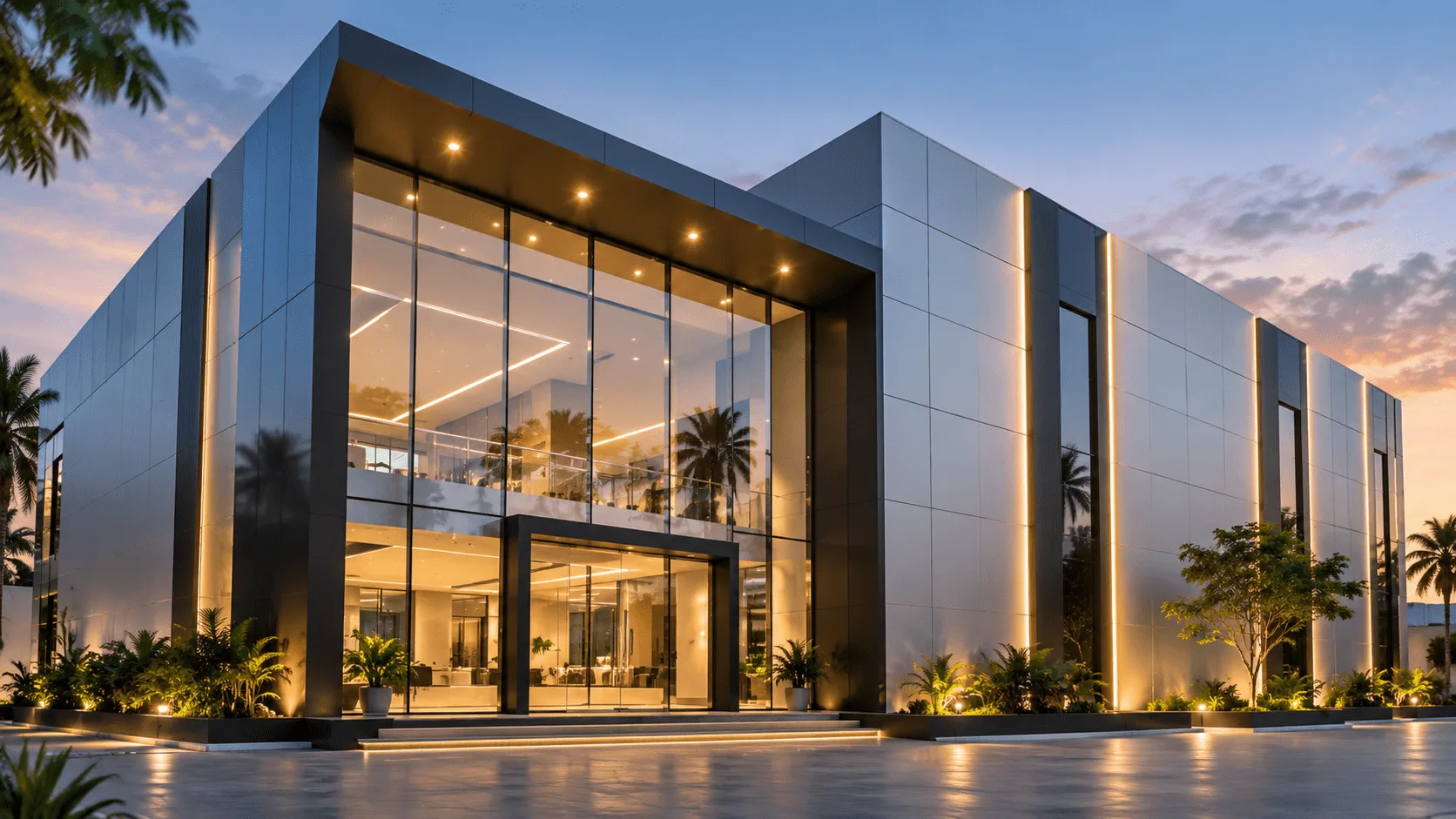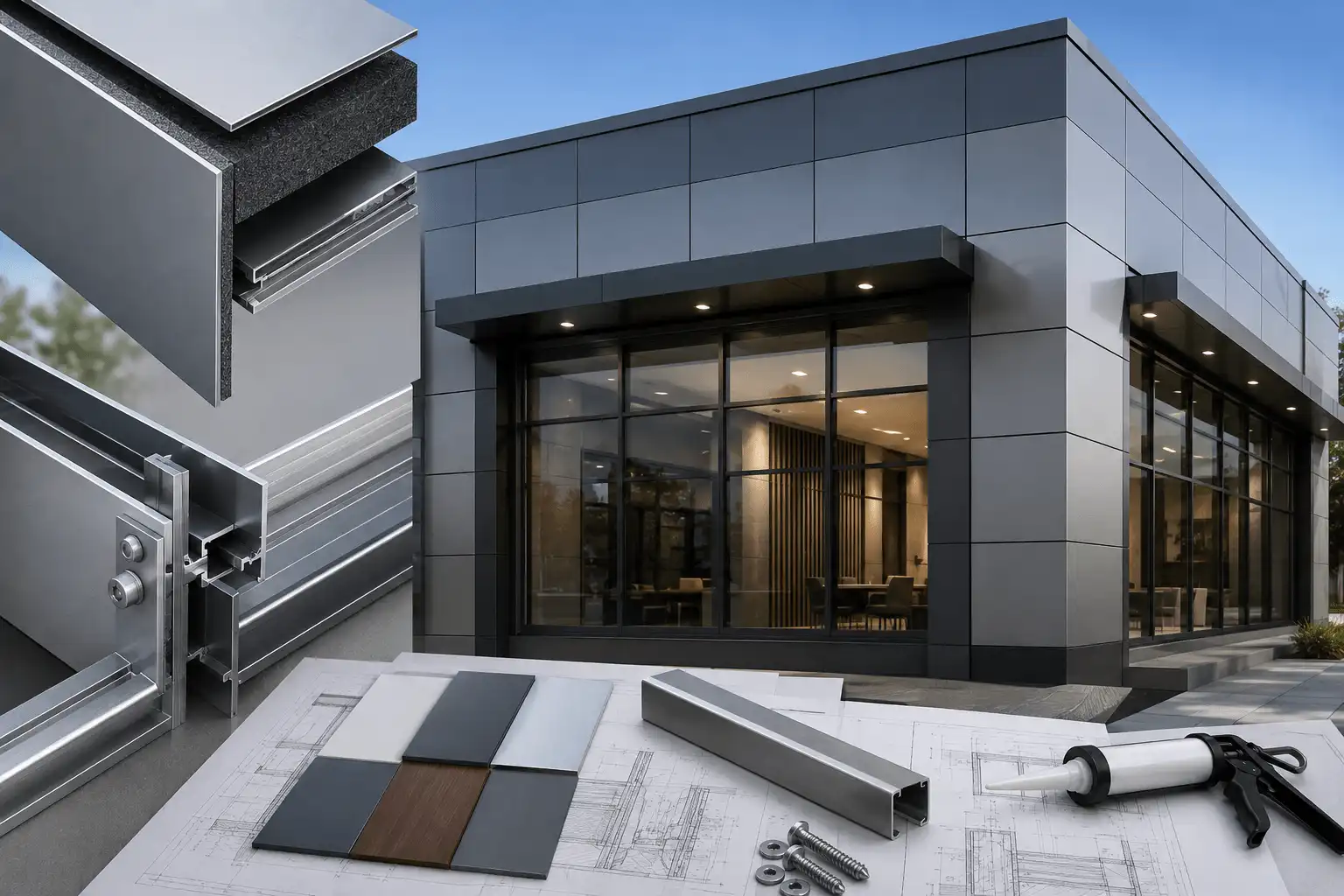
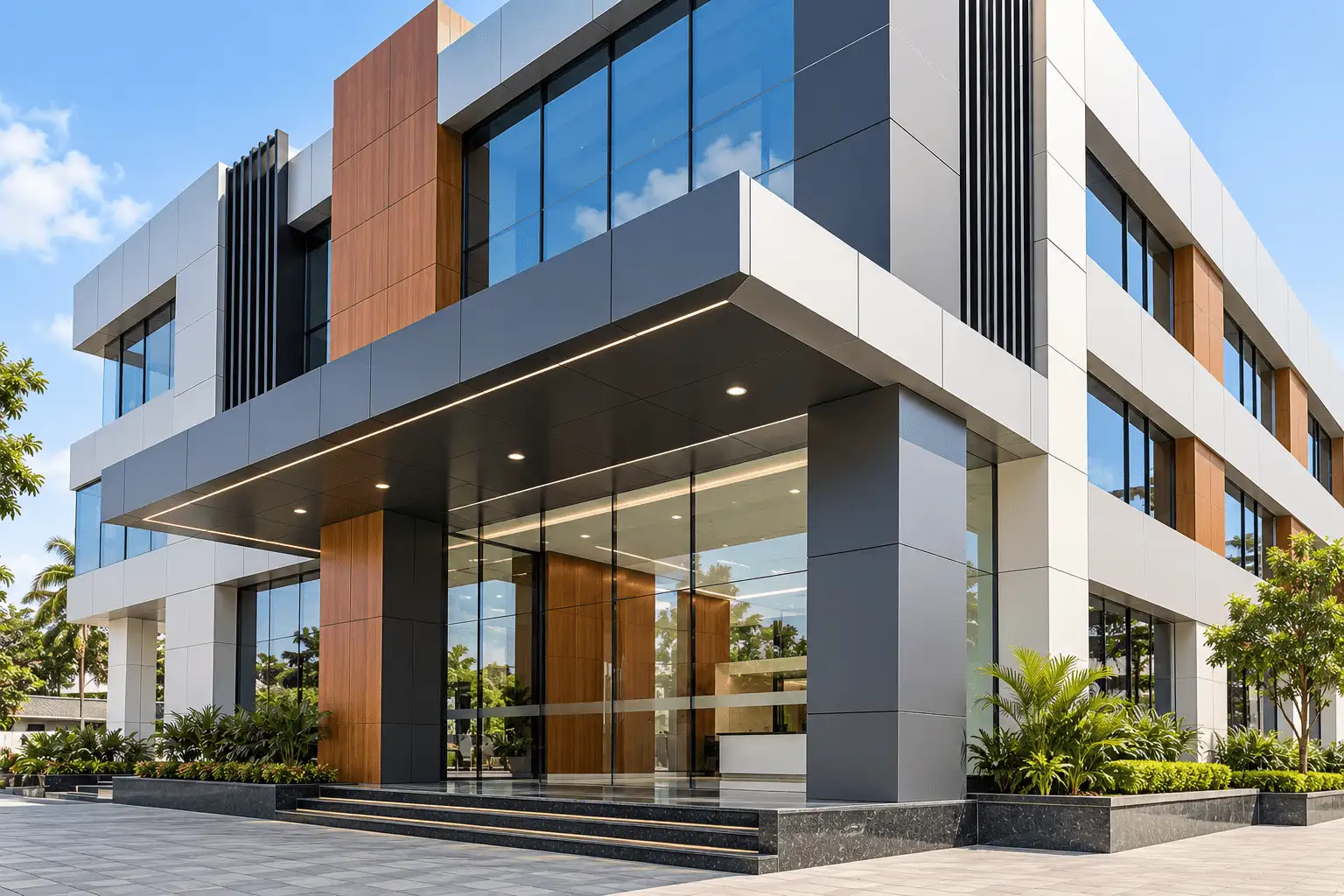
Drive along Avinashi Road in Coimbatore, OMR in Chennai, or the newer business stretches of Madurai and Tiruchirappalli, and the pattern is familiar. Offices, showrooms and business centres stand side by side, and the ones that get noticed have a clear, consistent exterior. Aluminium composite panel (ACP) cladding, used with glass and aluminium, is often part of the reason.
Why ACP Is Used for Commercial Facades
ACP is flat, comes in many colours and finishes, and can be cut, routed and folded to suit the building. It is relatively lightweight compared with many traditional facade finishes, but the whole cladding system, including the sub-frame and fixings, still has to be assessed for the structure. One material can cover columns, parapets, canopies and feature walls, which keeps the facade consistent. Compared with plaster and paint, ACP can hold its appearance longer, provided the panels and coatings are well chosen, the installation is careful and the facade is maintained.
A Professional Corporate Exterior
Clients form an opinion of a company before they meet anyone. Stained plaster, mismatched additions and a tangle of boards suggest disorder. A limited palette, straight joints and even gaps suggest the opposite. Restraint works well here: one dominant tone, one accent for the brand, and generous plain surfaces. The facade should support the company’s image, not compete with it.
Entrance and Reception Identity
The entrance is where the facade works hardest. A projecting canopy, a framed entrance volume or a change of panel colour tells visitors where to go, even from the road. Keep the reception zone easy to find, with a clear glazed opening where the layout permits and a clean surface beside it for the company name. A sheltered approach is practical for visitors arriving on two-wheelers, in cars or on foot, in both summer sun and monsoon rain.
ACP, Glass and Aluminium Together
The strongest office facades give each material a clear role: glass for openings, aluminium for frames, fins and trims, and ACP for the solid planes. Window positions, floor levels and panel joints should line up so the facade reads as one composition. Glass brings in natural light, but large unshaded openings facing west can bring heat and glare, especially in Chennai, Madurai and the inland cities. The balance between ACP and glass should follow orientation, building use and the architect’s design, not looks alone.
Commercial Facade Material Planning
| Facade Element | Typical Application | Main Design Consideration |
|---|---|---|
| ACP Cladding | Columns, parapets, canopies, solid walls | Panel finish, joint detailing and fire documentation |
| Glass | Office windows, entrances, reception | Orientation, heat, glare and daylight |
| Aluminium | Frames, fins, trims | Alignment with ACP and glazing |
| CNC Jali / ACP Screens | Stair cores, balconies, parking and service areas | Ventilation, access and secondary-screen role |
| Pylon / Monument Sign | Road frontage, entrance and gate | Structural frame, anchoring and wind design |
| Signage | Company name, logo and tenant identification | Grid, visibility and wiring coordination |
| Facade Lighting | Entrance, canopy and signage | Concealed wiring and controlled lighting |
Frontage, Columns, Parapets and Feature Walls
These are the places where ACP is most often used. Clad columns give a clean vertical rhythm, a neat parapet finishes the roof edge, and a feature wall at reception or a stair core can carry the brand colour without turning the building into an advertisement.
Branding, Signage and Pylons
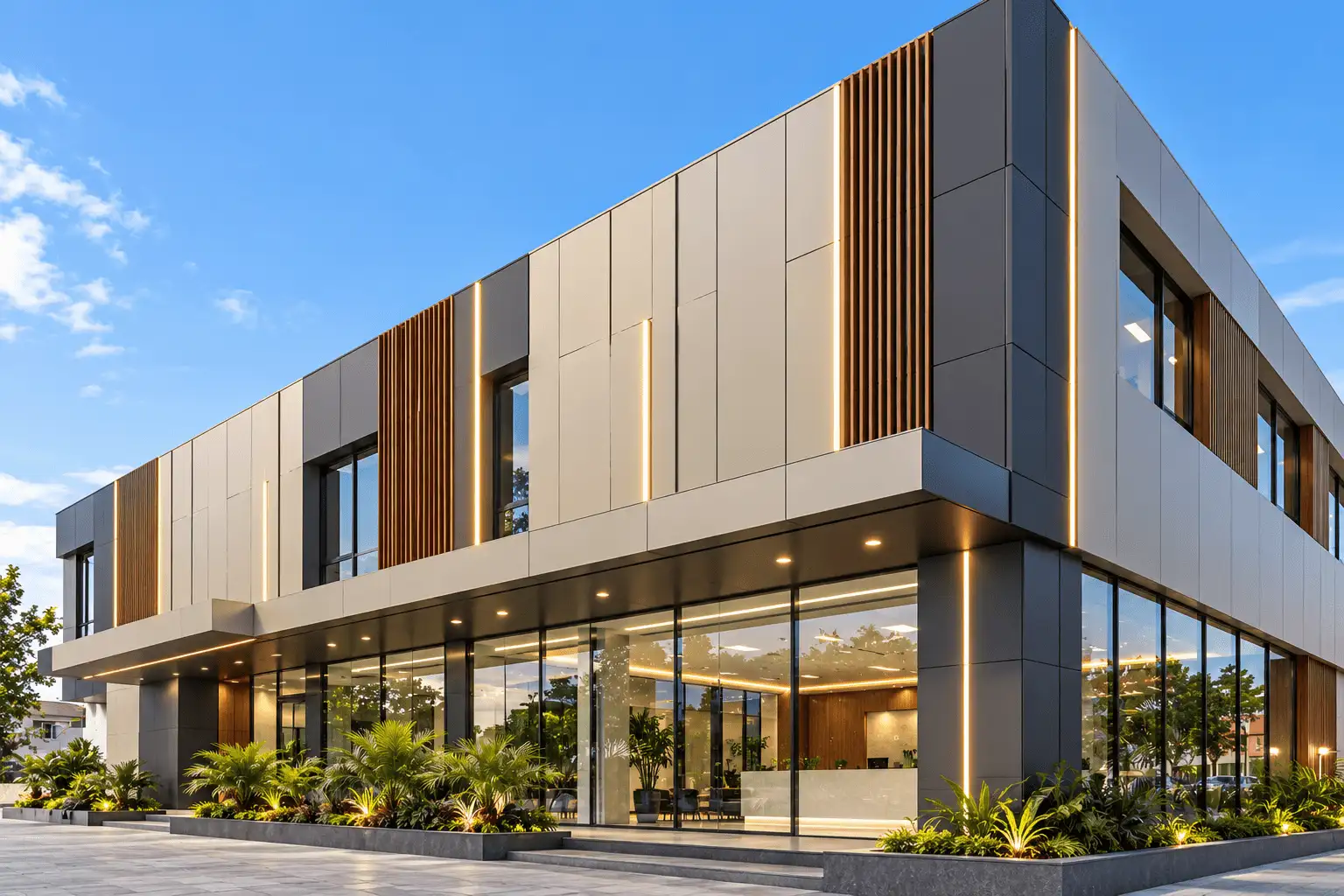
Signage works best when planned with the facade rather than added afterwards. Panel modules can set the grid for logos, lettering and tenant names, with routed channels, fixed letters or backlit signs, and wiring planned before the panels go up. Where the site requires it, a standalone pylon or monument sign near the road or gate can identify the building before visitors arrive. It needs an internal structural frame, with ACP forming the finished outer skin. The ACP is the cladding, not the structure, and the frame, anchoring and wind resistance should be designed for the actual site by a qualified consultant.
Selective Use of CNC Jali and Service Areas
CNC jali or ACP screens are best used selectively, on stair cores, balconies and parking decks. They are also useful for service areas. AC outdoor units, ducts and utility zones can spoil a tidy elevation, and a screened enclosure hides them while still letting air reach the equipment, provided the openings, clearances and service access suit the equipment. A screen is a secondary element and does not replace the weather protection of the wall behind it. More on this in CNC Jali & ACP Screens.
Weather, Drainage and Maintenance
Tamil Nadu is demanding on exteriors. Strong sun, salt air along the coast, dust on busy highways and heavy northeast monsoon rain all test a facade. Good design deals with drainage, well-detailed sealed joints, and avoids flat ledges where water and dust collect. Choose coatings with a documented warranty, since lower-quality coatings may show earlier fading, chalking or surface deterioration under prolonged exposure. Plan cleaning access too, because a facade that cannot be washed will not stay clean.
Colour and Finish
Neutral tones such as white, grey, charcoal and muted earth shades suit commercial buildings and age well. Light-coloured finishes can reduce surface solar heat absorption, though overall thermal performance depends on the complete facade assembly. Matt or low-gloss finishes reduce glare and hide small imperfections better than mirror finishes. Save bright brand colours for a limited area such as the canopy, entrance or a feature wall.
Renovating an Existing Office Building
Many older commercial blocks in Salem, Erode, Tiruppur and Tirunelveli have faded plaster and unplanned additions. ACP cladding over a new sub-frame can give them a single, updated face. Survey the existing wall first, including moisture and structure, because cladding should never be used to hide a leaking wall.
Key Commercial Facade Planning Points
- Define the building’s visual identity before selecting ACP colours.
- Coordinate ACP, glass and aluminium grid lines.
- Keep the entrance and reception clearly identifiable.
- Plan signage before ACP fabrication.
- Use CNC screens selectively where they serve a purpose.
- Provide access around AC and utility equipment.
- Detail drainage, joints and water management.
- Check fire classification and documentation.
- Design the sub-frame and fixings for site-specific wind conditions.
- Prepare a sample panel or mock-up before full fabrication.
Practical Points Before You Start
Check the ACP’s fire classification and test documentation, and confirm the requirements for your building with the architect and local authority. Thickness alone says nothing about fire performance. Have the sub-frame, brackets and fixings designed for the wind conditions of the site. Ask for a sample panel and a mock-up of the entrance. Treat design, CNC fabrication, framing, installation and finishing as one planned process. See our ACP cladding work.
Conclusion
A commercial facade is often the first thing a client sees. With simple design, careful detailing and an understanding of Tamil Nadu’s weather, ACP can give an office a clear, professional identity that lasts.